Country
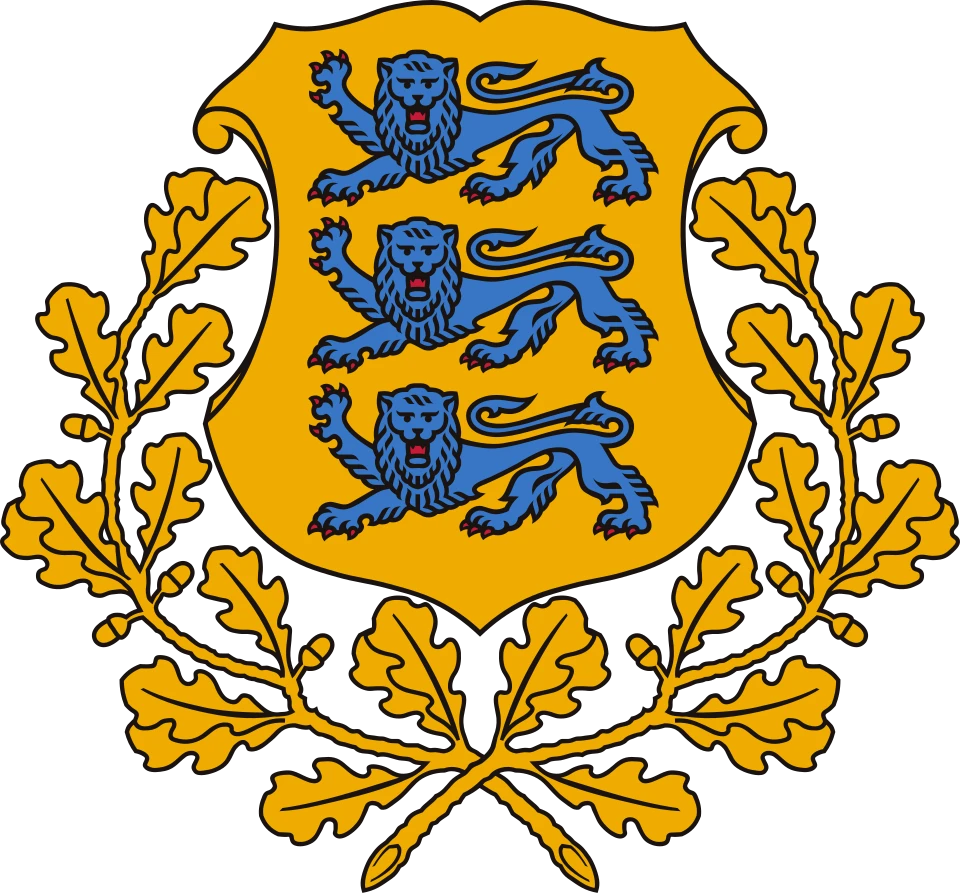
Estonia’s coat of arms bears a remarkable inheritance: three blue lions on a golden shield, derived from the royal arms of King Valdemar II of Denmark, who conquered northern Estonia in 1219. Eight centuries later, these Danish lions — reinterpreted as symbols of Estonian courage — still define the nation’s heraldic identity. The national flag, the beloved sinimustvalge (“blue-black-white”), was born not on a battlefield but in a student meeting at the University of Tartu in 1881, sewn by Paula Hermann in her kitchen, and consecrated at a clandestine church service in Otepää on 4 June 1884 under Russian imperial rule. Both symbols were suppressed during the Soviet occupation (1940–1991) and triumphantly restored at independence.

Flag
Not available
Coat of Arms
Not available
| Official name | Eesti Vabariik |
|---|---|
| Coat of arms | Golden shield, three blue lions passant guardant, oak branches |
| Blazon | Or, three lions passant guardant Azure armed and langued Gules |
| Arms adopted | 19 June 1925 (Riigikogu); restored 7 August 1990 |
| National flag | Sinimustvalge — horizontal blue, black, white |
| Flag consecrated | 4 June 1884 (Otepää) |
| Capital | Tallinn |
| Government | Unitary parliamentary republic |
| Head of State | Alar Karis (since 2021) |
| Heraldic origin | Arms of King Valdemar II of Denmark (1219) |
Coat of Arms of Estonia — Or, three lions passant guardant Azure
The coat of arms of the Republic of Estonia (Eesti vapp) centres on a golden shield bearing three blue lions, flanked by golden oak branches. Its blazon reads:
Or, three lions passant guardant Azure, armed and langued Gules.
The three lions trace directly to the royal arms of King Valdemar II of Denmark, who conquered northern Estonia — including what is now Tallinn — during the Northern Crusades in 1219. The Duchy of Estonia (1219–1346) was part of the Danish Crown, and the lions remained as the heraldic symbol of the region through centuries of Teutonic, Swedish, and Russian rule.
When Estonia declared independence in 1918, the three lions were a natural choice for the new republic’s arms. The Great and Small State Coats of Arms were confirmed by the Riigikogu (Parliament) on 19 June 1925. According to the interpretation proposed by Leopold Raudkepp, each lion represents an act of Estonian courage:
The golden oak branches framing the shield symbolise strength, endurance, and the Estonian connection to the land.
During the Soviet occupation (1940–1941, 1944–1990), the three-lion arms were replaced by the emblem of the Estonian SSR. The historic coat of arms was restored on 7 August 1990, a year before Estonia regained full independence.
Flag of Estonia — Sinimustvalge, consecrated at Otepää, 4 June 1884
The Estonian flag — the sinimustvalge (“blue-black-white”) — is a horizontal tricolour of blue, black, and white. Its origins lie not in politics or war, but in a university student society.
On 29 September 1881, members of the Vironia student society at the University of Tartu gathered to select their colours. The criteria: the colours must evoke Estonian nature, harmonise with folk costume traditions, and be distinct from the six existing student corporations. After deliberation, blue, black, and white were chosen.
The first flag was hand-sewn by Paula Hermann, wife of Dr Karl August Hermann, in the spring of 1884 in Tartu. Because flying it was forbidden under Russian imperial rule, the flag was consecrated at a semi-secret church service on 4 June 1884 in Otepää, on the invitation of pastor Burchard Sperrlingk. June 4 is now celebrated as Estonian Flag Day.
By the early 20th century, the sinimustvalge had become the de facto flag of the Estonian-speaking people. It was officially adopted as the national flag upon independence in 1918. Suppressed during the Soviet occupation, it was re-hoisted atop Pikk Hermann tower in Tallinn on 24 February 1989 — two years before independence was formally restored.
Estonia’s heraldic heritage reflects its layered history under Danish, Teutonic, Swedish, and Russian sovereignty. The Baltic German nobility (Ritterschaft) maintained elaborate heraldic registers — the Matrikel of the Estonian and Livonian knighthoods — that are among the best-documented noble rolls in Northern Europe.
Municipal heraldry is particularly rich. Tallinn’s arms — three blue lions on gold, matching the national arms but with a distinct arrangement — date to the Danish period. Tartu, Pärnu, Narva, and Haapsalu all bear historic arms reflecting their Hanseatic and episcopal past. Estonia’s 15 counties (maakonnad) each maintain official coats of arms, many incorporating regional charges such as the sword of the bishop of Ösel-Wiek or the anchor of the coastal towns.
The three blue lions derive from the royal arms of King Valdemar II of Denmark, who conquered northern Estonia in 1219. The Duchy of Estonia (1219–1346) was part of the Danish realm, and the lions remained as the heraldic symbol of the region long after Danish rule ended. Estonia adopted them as its national coat of arms when it became independent in 1918, formalised by the Riigikogu on 19 June 1925.
Sinimustvalge is Estonian for “blue-black-white” — a straightforward description of the flag’s three colours. It is the unofficial but universally used name for the Estonian national flag. The colours were chosen on 29 September 1881 by the Vironia student society at the University of Tartu.
The first physical flag was sewn by Paula Hermann in the spring of 1884 in Tartu. Because flying it was forbidden under Russian imperial rule, it was consecrated at a semi-secret church service on 4 June 1884 in Otepää, on the invitation of pastor Burchard Sperrlingk. June 4 is now celebrated as Estonian Flag Day.
According to the interpretation by Leopold Raudkepp, the three lions represent three acts of Estonian courage: the fight for freedom in ancient times, the St George’s Night Uprising in Harjumaa in 1343, and the struggle for independence in the 20th century. They are blazoned as Or, three lions passant guardant Azure armed and langued Gules.
Blue symbolises the Estonian sky, loyalty, and devotion; black represents the dark past and the native soil; and white stands for the aspiration toward enlightenment, purity, and snow. The colours were also chosen to harmonise with Estonian folk costume traditions and to distinguish Estonia from other student corporations at the University of Tartu.
Last reviewed by the Emblema Mundi editorial team on 2026-06-22.