Country
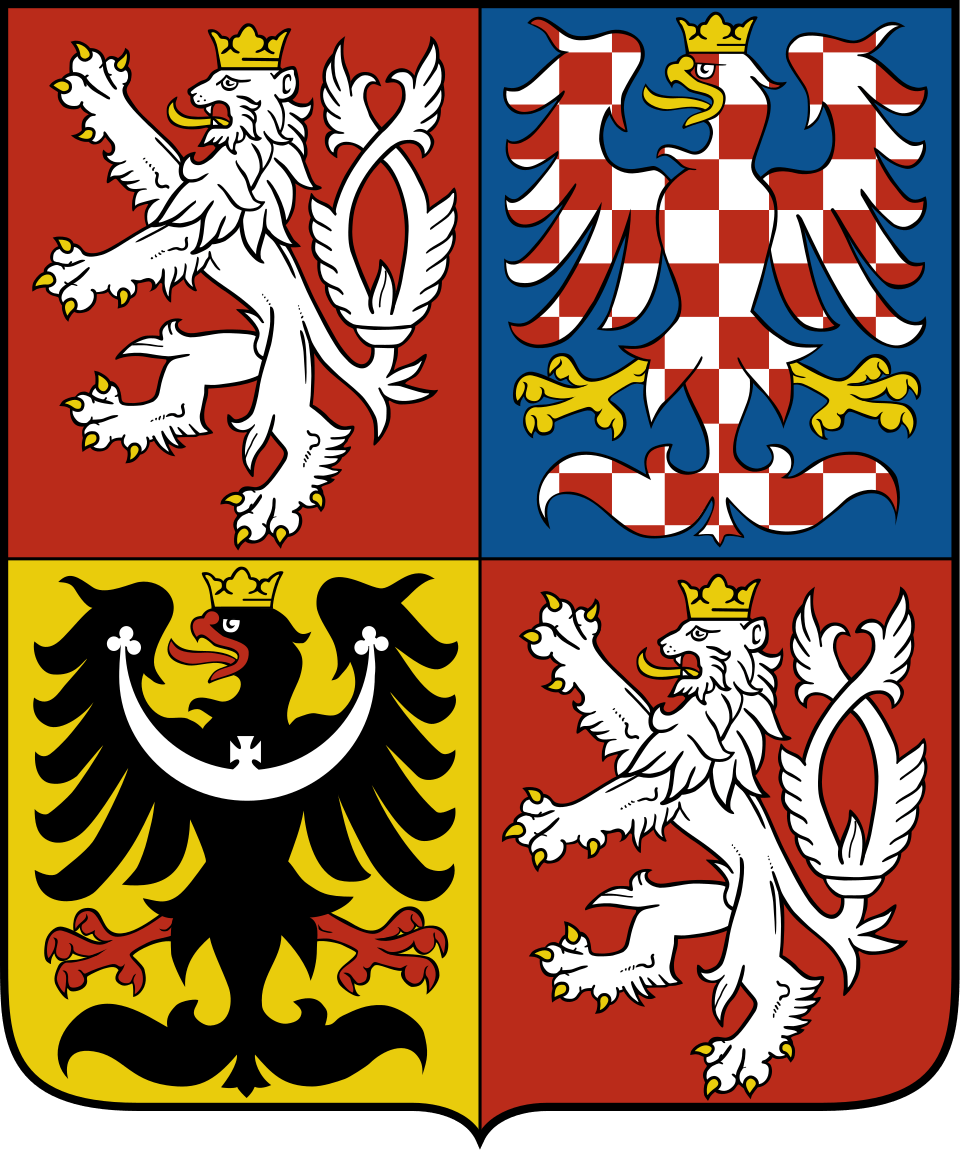
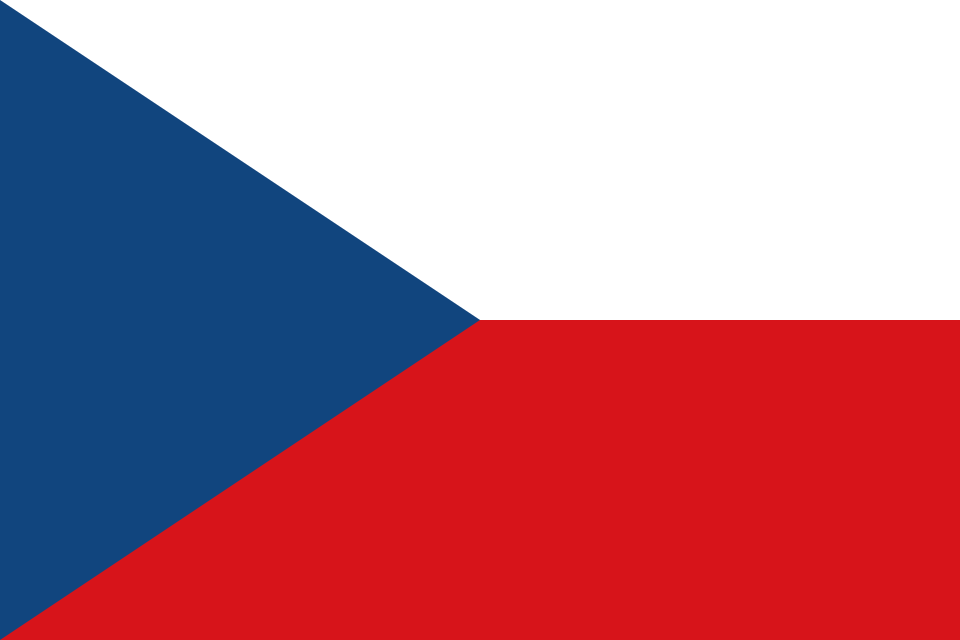
The double-tailed lion of Bohemia — český lev — is one of the most iconic charges in European heraldry. A silver lion rampant with a forked tail, crowned in gold on a red shield, it has represented the Bohemian Crown since King Přemysl Otakar II adopted it in 1249. The greater coat of arms of Czechia, designed by heraldist Jiří Louda in 1992, quarters this celebrated lion with the chequered eagle of Moravia and the black eagle of Silesia — the three historic lands of the Koruna česká (Bohemian Crown) united on a single shield. The national flag — white and red with a blue triangle at the hoist — was designed by Jaroslav Kursa for Czechoslovakia in 1920 and kept by the Czech Republic after the 1993 dissolution.
Flag
Not available
Coat of Arms
Not available
| Official name | Česká republika / Czechia |
|---|---|
| Greater coat of arms | Quartered: Bohemian lion, Moravian eagle, Silesian eagle |
| Lesser coat of arms | Gules, a lion rampant queue forchée Argent, crowned Or |
| Arms adopted | 1992 (designed by Jiří Louda) |
| National flag | White-red bicolour with blue triangle at hoist |
| Flag adopted | 30 March 1920 (Czechoslovakia); retained 1993 |
| Flag designer | Jaroslav Kursa |
| Capital | Praha |
| Government | Unitary parliamentary republic |
| Head of State | Petr Pavel (since 2023) |
Coat of Arms of Czechia — Bohemia, Moravia, Silesia quartered
The greater coat of arms of Czechia is a quartered shield uniting the three historic lands of the Bohemian Crown. Its full blazon reads:
Quarterly: 1st and 4th, Gules, a lion rampant queue forchée Argent, armed, langued and crowned Or (Bohemia); 2nd, Azure, an eagle displayed chequé Gules and Argent, armed, langued and crowned Or (Moravia); 3rd, Or, an eagle displayed Sable, armed and langued Gules, crowned Or, charged on the breast with a crescent terminating in trefoils with a cross pattée Argent (Silesia).
The silver double-tailed lion (český lev) is the oldest and most prominent element. It first appeared on the seal of King Vladislav II around 1198 and was formally adopted as the Bohemian royal charge by Přemysl Otakar II in 1249. The double tail (queue forchée) is the lion’s most distinctive feature — no other European kingdom uses a double-tailed lion as its primary charge. It makes the Bohemian arms instantly recognisable across the continent.
The chequered eagle — Gules and Argent (red-and-silver) — on a blue field represents Moravia, the eastern region of the Czech lands. The chequered pattern is unique among European heraldic eagles and has been associated with Moravia since the 13th century. The Moravian eagle is one of the most celebrated charges in Central European heraldry.
The black eagle on a golden field represents Silesia, the historic territory divided between modern Czechia and Poland. The eagle bears a distinctive charge on its breast: a crescent terminating in trefoils with a cross pattée issuing from its centre — the so-called příhrada, a uniquely Silesian heraldic device.
The lesser coat of arms displays only the Bohemian lion: Gules, a lion rampant queue forchée Argent, armed, langued and crowned Or. It is used in contexts where a simpler symbol is needed — on passports, government documents, and everyday official use.
The current coats of arms were designed by Jiří Louda, one of the foremost Czech heraldists, and adopted in 1992 following the dissolution of Czechoslovakia. They restored the traditional quartered shield of the Bohemian Crown that had been replaced by socialist emblems during the communist era.
Flag of Czechia — White-red with blue triangle, designed by Jaroslav Kursa, 1920
The Czech flag is a white-and-red horizontal bicolour with a blue triangle extending from the hoist to the centre of the flag.
After Czechoslovakia was established in 1918, the new state initially used the historic Bohemian flag: white over red. This was nearly identical to the Polish flag officially adopted in 1919, creating confusion. A solution was needed.
Jaroslav Kursa, an archivist at the Czechoslovak Ministry of the Interior, proposed adding a blue triangle at the hoist. He explained that the triangle represented the three blue hills on the Slovak coat of arms, incorporating Slovakia into the flag’s symbolism. A subcommittee decided on 23 January 1920 to extend the triangle to the midpoint of the flag. The design was approved by the National Assembly on 30 March 1920.
The Nazis banned the flag in 1939 during the Protectorate of Bohemia and Moravia. It was restored in 1945 and survived the entire communist period unchanged — one of only three socialist flags in Europe that never bore a state emblem at its centre. When Czechoslovakia dissolved on 1 January 1993, the Czech Republic retained the flag, while Slovakia adopted its own design.
The Bohemian Crown (Koruna česká) was one of the great heraldic centres of mediaeval Europe. The Přemyslid dynasty established the Bohemian lion as a royal charge in the 13th century, and the subsequent Luxembourg dynasty — particularly Emperor Karel IV — elevated Prague into a capital of heraldic culture within the Holy Roman Empire.
Czech municipal heraldry is exceptionally rich. Praha’s arms feature the city’s historic gates and towers, while Bohemian and Moravian towns such as Brno, Olomouc, Plzeň, and České Budějovice bear arms dating to their mediaeval charters. The 13 regions (kraje) of the modern Czech Republic each maintain official coats of arms that incorporate elements from the historic Bohemian, Moravian, and Silesian heraldic traditions.
The silver double-tailed lion (český lev) on a red field is the heraldic symbol of Bohemia, first documented on the seal of King Vladislav II around 1198 and formally introduced by King Přemysl Otakar II in 1249. The double tail (queue forchée) distinguishes the Bohemian lion from all other European heraldic lions. It occupies the 1st and 4th quarters of the greater coat of arms.
The greater coat of arms is quartered: the 1st and 4th quarters bear the Bohemian lion (silver double-tailed lion on red), the 2nd quarter shows the Moravian eagle (a chequered red-and-silver eagle on blue), and the 3rd quarter displays the Silesian eagle (a black eagle on gold). Together they represent the three historical lands of the Bohemian Crown.
The current coat of arms was designed by Czech heraldist Jiří Louda and adopted in 1992, following the dissolution of Czechoslovakia. It restored the traditional quartered shield of the Bohemian Crown lands.
The blue triangle was added in 1920 to distinguish the Czechoslovak flag from the nearly identical Polish flag. Designed by Jaroslav Kursa, the triangle originally represented Slovakia and Subcarpathian Ruthenia. When Czechoslovakia dissolved in 1993, the Czech Republic kept the flag despite Slovakia’s departure.
The lesser coat of arms shows only the Bohemian lion: Gules, a lion rampant queue forchée Argent, armed, langued and crowned Or. It is used in everyday official contexts, while the greater (quartered) arms serve as the full state coat of arms.
Last reviewed by the Emblema Mundi editorial team on 2026-06-22.