Country
Few national symbols are as tightly bound to a single hero as those of Albania. The double-headed eagle — shqiponja — and the golden helmet that crowns the coat of arms both trace directly to Gjergj Kastrioti Skanderbeg, the nobleman who defied the Ottoman Empire for twenty-five years in the 15th century. When Ismail Qemali proclaimed independence at Vlorë on 28 November 1912, the flag he raised was Skanderbeg’s own: a black eagle on a red field. Codified by Law No. 8926 of 22 July 2002, the coat of arms remains an enduring link between modern Albania and the mediaeval resistance that forged its identity.
Flag
Not available
Coat of Arms
Not available
| Official name | Republika e Shqipërisë |
|---|---|
| Coat of arms | Red shield, black double-headed eagle, Skanderbeg’s golden helmet |
| Blazon | Gules, a double-headed eagle displayed Sable, in chief the helm of Skanderbeg Or |
| Arms adopted | 22 July 2002 (Law No. 8926) |
| National flag | Red field, black double-headed eagle |
| Flag raised | 28 November 1912 (Vlorë, independence) |
| Capital | Tiranë |
| Government | Unitary parliamentary republic |
| Head of State | Bajram Begaj (since 2022) |
| National hero | Gjergj Kastrioti Skanderbeg (1405–1468) |
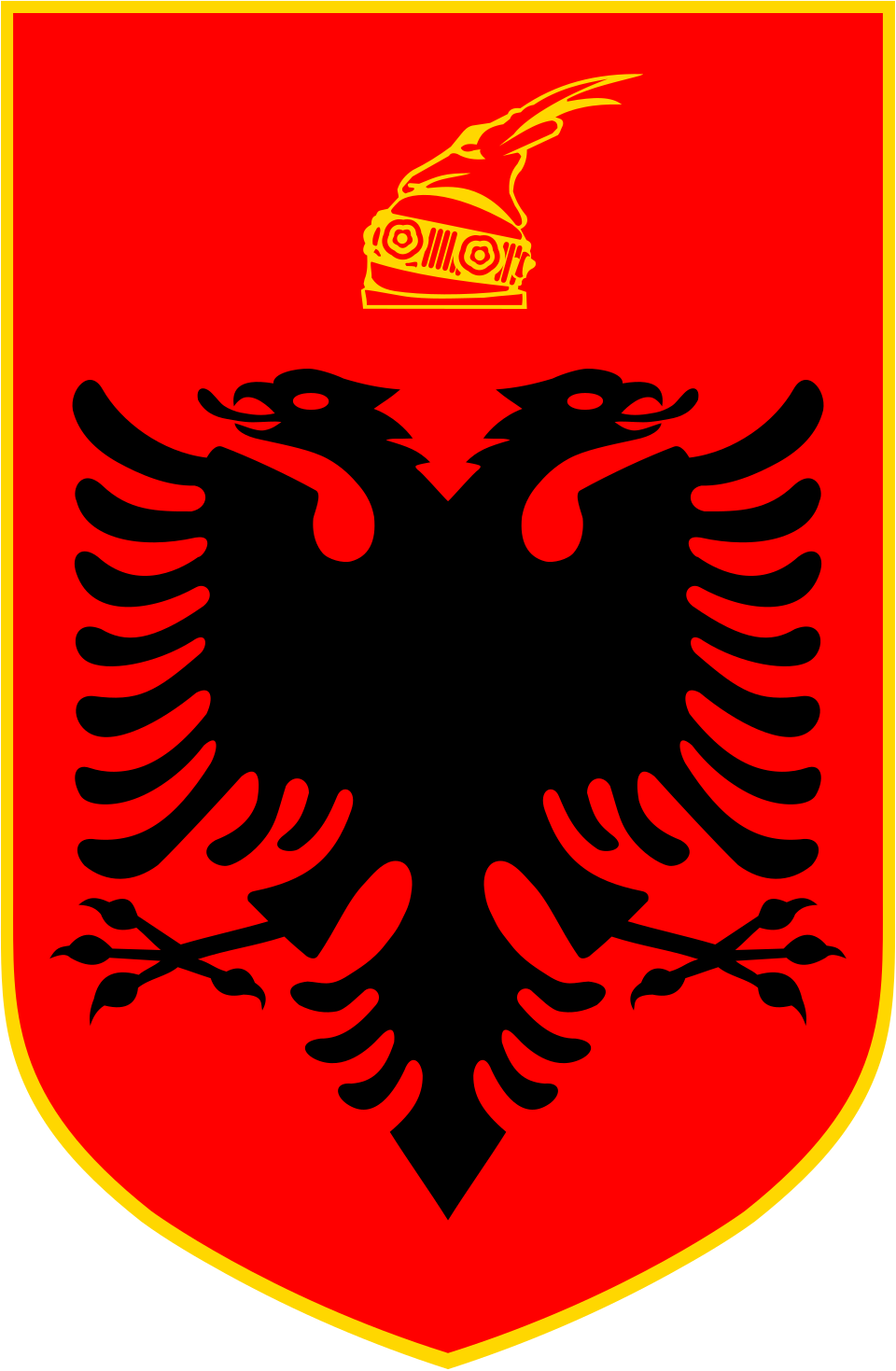
Coat of Arms of Albania — Gules, a double-headed eagle displayed Sable, in chief the helm of Skanderbeg Or
The Albanian coat of arms is an adaptation of the national flag, enriched with the most iconic artefact in Albanian history — the helmet of Skanderbeg. Its blazon reads:
Gules, a double-headed eagle displayed Sable, in chief the helm of Skanderbeg Or.
The black double-headed eagle (shqiponja dykrenare) has roots in Byzantine imperial heraldry, but it became inseparable from Albanian identity through the Kastrioti family. The earliest documented Albanian use dates to 1458: a sealed letter in the Vatican Secret Archive addressed to Pope Pius II, co-sealed by notary Johannes Borcius de Grillis, bears the eagle as the symbol of Skanderbeg’s alliance.
Albanians call themselves shqiptarë — often interpreted as “sons of the eagle” — and the country Shqipëria, the “land of eagles.” Whether this etymology is folk or factual, the eagle and the nation have been symbolically fused for centuries.
Above the eagle sits a stylised golden helmet adorned with six eagle plumes. It is based on a real artefact: a rank crown that belonged to Gjergj Kastrioti Skanderbeg, now displayed at the Kunsthistorisches Museum in Vienna. The helmet was first recorded in the 1593 Ambras armoury inventory and depicted in Jakob Schrenck von Notzing’s Armamentarium Heroicum (1601–1603). Ferdinand II of Austria acquired it from the Duke of Urbino, as documented in a letter dated 15 October 1578.
Law No. 8926, enacted on 22 July 2002, establishes the coat of arms as an official state symbol of the Republic of Albania. The design depicts a red shield bearing the black double-headed eagle surmounted by the golden helmet — elements that have remained essentially unchanged since Skanderbeg’s era.
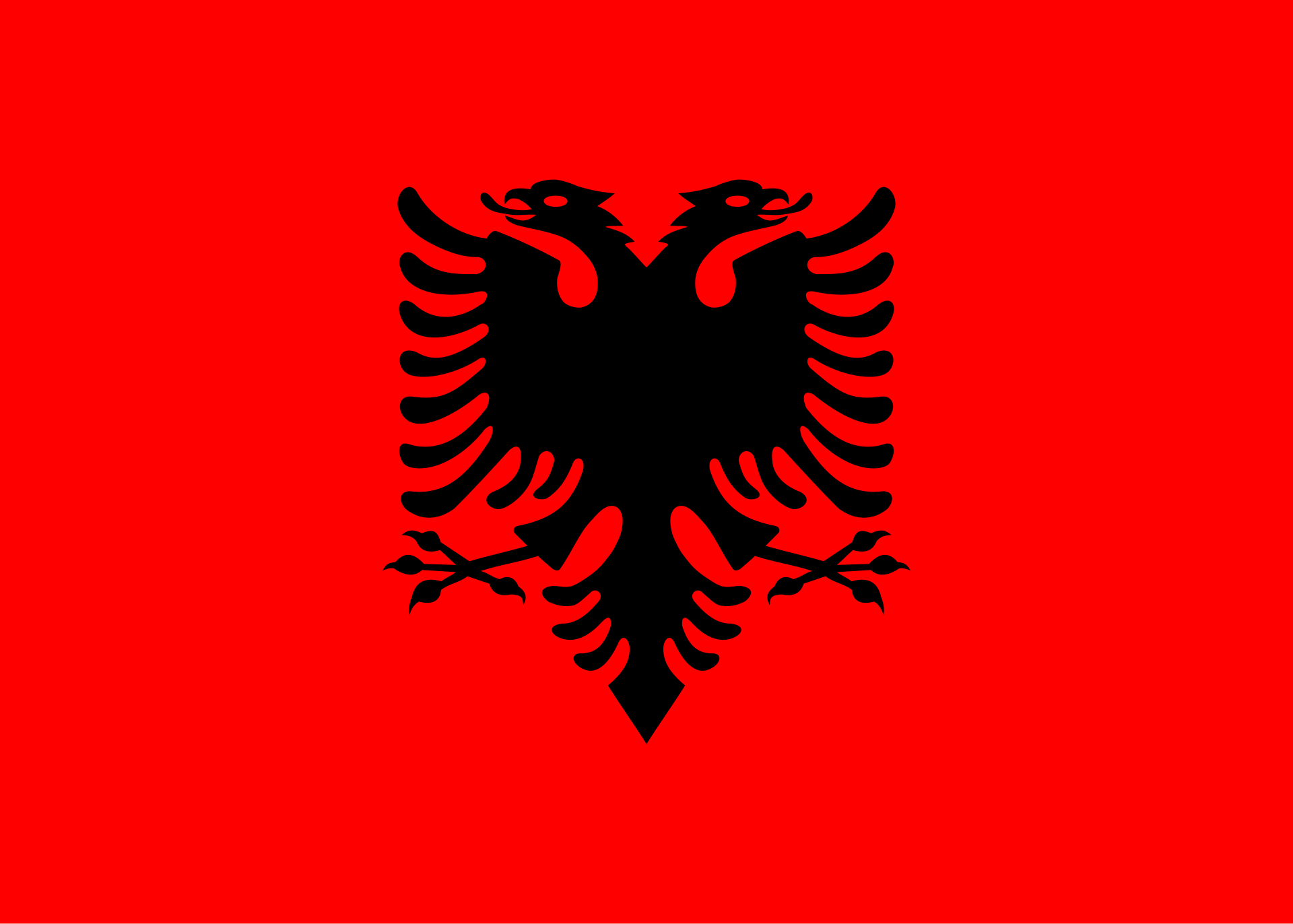
Flag of Albania — Raised at Vlorë, 28 November 1912
The Albanian flag is strikingly minimalist: a black double-headed eagle centred on a red field. No stars, no crescent, no text — just two bold elements that have defined Albanian identity for over five centuries.
During John Hunyadi’s campaign at Niš in 1443, Skanderbeg and several hundred Albanians defected from the Ottoman ranks. He adopted the double-headed eagle on a red field as his personal standard — a design rooted in the Eastern Roman imperial tradition. For twenty-five years, this banner flew over a resistance that stunned the Ottoman Empire and captivated Renaissance Europe.
The Albanian national movement of the 19th century — the Rilindja Kombëtare — built an explicit historical line from Skanderbeg to itself. Intellectuals across the diaspora published Skanderbeg histories, poetry, and iconography in Albanian-language journals. By 1912, the connection was canonical: the new Albanian state would not design a new symbol.
On 28 November 1912, Ismail Qemali proclaimed independence at Vlorë. According to the memoirs of Eqrem Vlora, the specific flag raised that day had been given to him in Paris around 1909 by Don Aladro Kastriota, a Spanish-Albanian descendant of the Kastrioti family — a direct material link between Skanderbeg’s lineage and the birth of the modern state.
The red (Gules) stands for bravery, strength, valour, and the blood shed for independence. The black eagle represents the sovereign Albanian state and the nation’s resilience through centuries of foreign domination.
Albanian heraldry is deeply tied to the mediaeval noble families that governed the principalities and lordships of the Balkans before and during the Ottoman period. Several Albanian dynasties bore distinctive arms:
Ottoman conquest disrupted indigenous heraldic development, but the double-headed eagle survived as a pan-Albanian national symbol, transcending regional and religious divisions. Today, the eagle appears not only on state arms but on the flags and emblems of Albanian communities across Kosovo, North Macedonia, and the diaspora.
The double-headed eagle (shqiponja) is the traditional symbol of the Albanian people, rooted in Byzantine imperial heraldry. It was adopted by Gjergj Kastrioti Skanderbeg around 1443 when he defected from the Ottoman army and raised the banner of Albanian resistance. The eagle represents sovereignty, strength, and the continuity of the Albanian nation.
Gjergj Kastrioti Skanderbeg (1405–1468) was an Albanian nobleman who led a 25-year resistance against the Ottoman Empire. He adopted the black double-headed eagle on a red field as his standard around 1443. His helmet — a golden casque with six eagle plumes — crowns the modern coat of arms. The original helmet is preserved at the Kunsthistorisches Museum in Vienna.
The flag was raised on 28 November 1912 in Vlorë, when Ismail Qemali proclaimed Albania’s independence from the Ottoman Empire. According to Eqrem Vlora’s memoirs, the specific flag had been given to him in Paris around 1909 by Don Aladro Kastriota, a Spanish-Albanian descendant of the Kastrioti family.
The golden helmet above the eagle is based on Skanderbeg’s rank crown, a casque adorned with six golden eagle plumes. The original artefact was acquired by Ferdinand II of Austria from the Duke of Urbino in 1578 and is now displayed at the Kunsthistorisches Museum in Vienna. It was first mentioned in the 1593 Ambras armoury inventory.
The red field (Gules) stands for bravery, strength, valour, and the blood shed for Albanian independence. Combined with the black eagle, the two-colour design — no stars, no crescent, no text — creates one of the most striking and minimalist national flags in Europe.
Last reviewed by the Emblema Mundi editorial team on 2026-06-22.