Autonomous Community
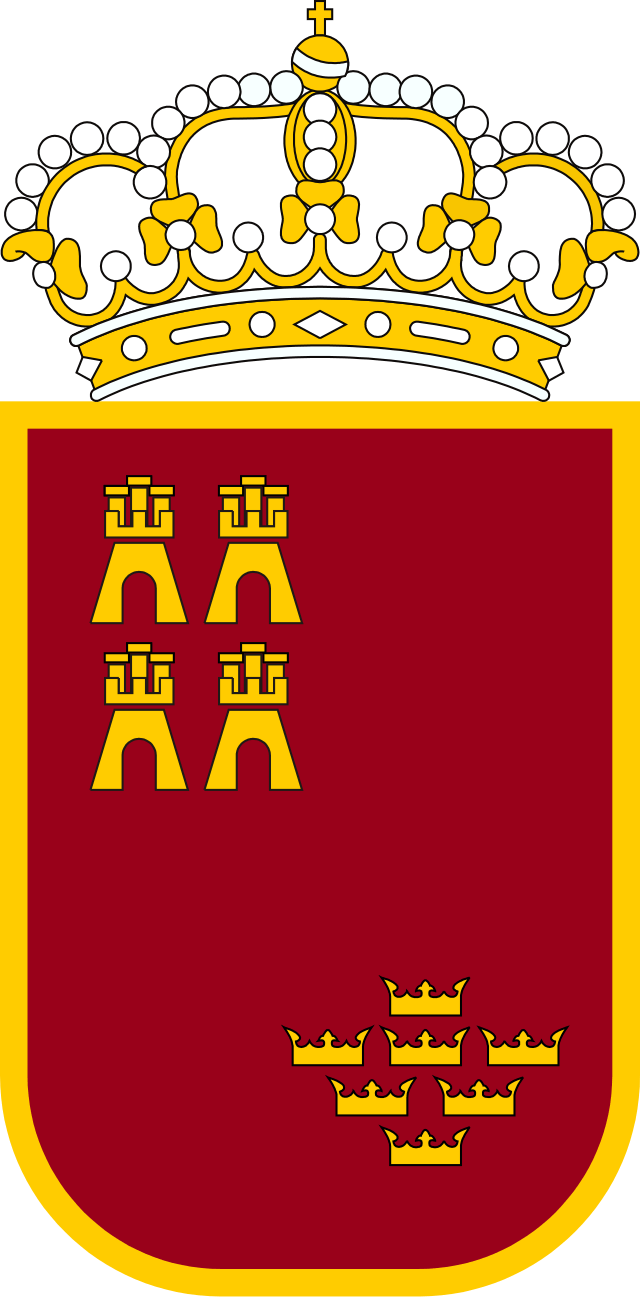
The Región de Murcia is an autonomous community in southeastern Spain, bordered by Andalusia, Castilla-La Mancha, the Valencian Community, and the Mediterranean Sea. It is the only Spanish province that forms a single-province autonomous community. Its coat of arms, dominated by four castles and the famous seven crowns (las siete coronas), directly reflects the military and political history of the medieval Kingdom of Murcia.
Flag
Not available
Coat of Arms
Not available
| Autonomous Community | Región de Murcia |
|---|---|
| Capital | Murcia |
| Statute of Autonomy | 9 June 1982 (Organic Law 4/1982) |
| Key symbols | Four castles, seven crowns (las siete coronas) |
| Coat of arms law | Regional Law 4/1982 |
| Location | Southeastern Spain, Mediterranean coast |
Coat of Arms of Región de Murcia — four castles and seven royal crowns on gules, adopted 1982
Gules, four castles Or arranged saltirewise; in chief, seven royal crowns Or. The shield ensigned with a closed royal crown.
The red (gules) field carries two sets of symbols. The four gold castles, arranged saltirewise (diagonally), recall the role of the Kingdom of Murcia as a fortified frontier zone during the Reconquista. Murcia was conquered from the Moors in 1243 by the Infante Alfonso (later Alfonso X of Castile) and served as a strategic buffer territory on the southeastern frontier between Christian and Muslim-held lands. The castles echo the national arms of Castile, reflecting Murcia's close ties to the Castilian crown. The seven royal crowns in chief — las siete coronas — represent the seven privileges (fueros, mercedes reales) granted by successive Spanish monarchs to the city of Murcia in recognition of its loyalty during sieges, uprisings, and dynastic crises across the medieval and early modern periods.
The arms of the Kingdom of Murcia trace back to the 13th century. After the Christian reconquest of 1243, the city of Murcia received successive royal favours which were commemorated heraldically over time. The modern coat of arms of the autonomous community was officialized by Regional Law 4/1982, shortly after the Statute of Autonomy came into force in June 1982.
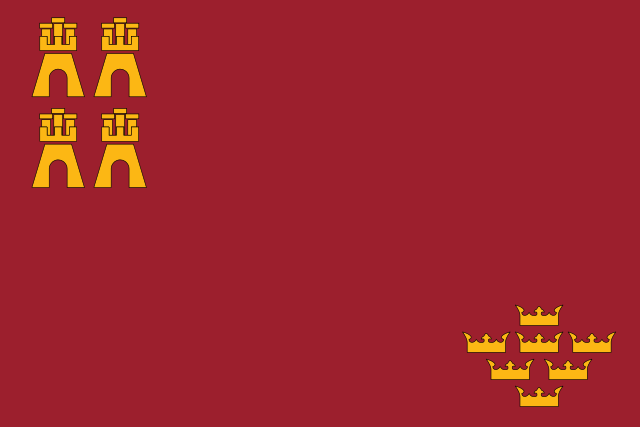
Flag of Región de Murcia — red field with seven crowns and four castles in gold
The flag of the Región de Murcia is a red (gules) field bearing, in the upper area, the seven gold royal crowns arranged in rows (4-2-1), and in the lower area, the four gold castles arranged in a square. The design reproduces the heraldic elements of the coat of arms directly on the flag surface, without a shield outline.
This approach — bringing the charges of the coat of arms onto the flag ground — is common in Spanish regional vexillology. The all-red background and all-gold charges give the flag a bold, distinctive appearance among Spanish regional flags.
The flag was officialized alongside the Statute of Autonomy in 1982 and flies on all public buildings in the region.
The seven crowns, known as las siete coronas, represent the seven royal privileges granted to the city of Murcia by successive Spanish monarchs in recognition of its loyalty during various uprisings, sieges and military crises throughout the medieval and early modern periods.
The four castles represent the role of the Kingdom of Murcia as a fortified frontier territory during the Reconquista. They recall the strategic military importance of the region as a buffer zone between Christian and Muslim-held lands after the conquest of 1243.
Gules, four castles Or arranged saltirewise, in chief seven royal crowns Or. The shield is ensigned with a closed royal crown. The arms were officialized by Regional Law 4/1982.
The Región de Murcia became an autonomous community of Spain in 1982, with its Statute of Autonomy approved on 9 June 1982 (Organic Law 4/1982). It is the only province in Spain that forms a single-province autonomous community.
The coat of arms is a quartered shield featuring four castles and seven crowns on a red field, ensigned with a royal crown. The flag reproduces these same heraldic elements directly on a red background, without the shield shape or the royal crown above it.
Last reviewed by the Emblema Mundi editorial team on June 29, 2026.