Autonomous Community
The Principado de Asturias is an autonomous community in the northwest of Spain, facing the Cantabrian Sea. Often called the "cradle of Spain," it was home to the medieval Kingdom of Asturias (718–925), the first Christian political entity to resist the Umayyad conquest of the Iberian Peninsula. Its coat of arms and flag are built around the Cruz de la Victoria — the Cross of Victory — one of the oldest and most venerated Christian relics of Spain.
Flag
Not available
Coat of Arms
Not available
| Autonomous Community | Principado de Asturias |
|---|---|
| Capital | Oviedo |
| Statute of Autonomy | 30 December 1981 |
| Key symbol | Cruz de la Victoria (Cross of Victory) |
| Historical origin | Kingdom of Asturias (718–925) |
| Patron saint | Our Lady of Covadonga |
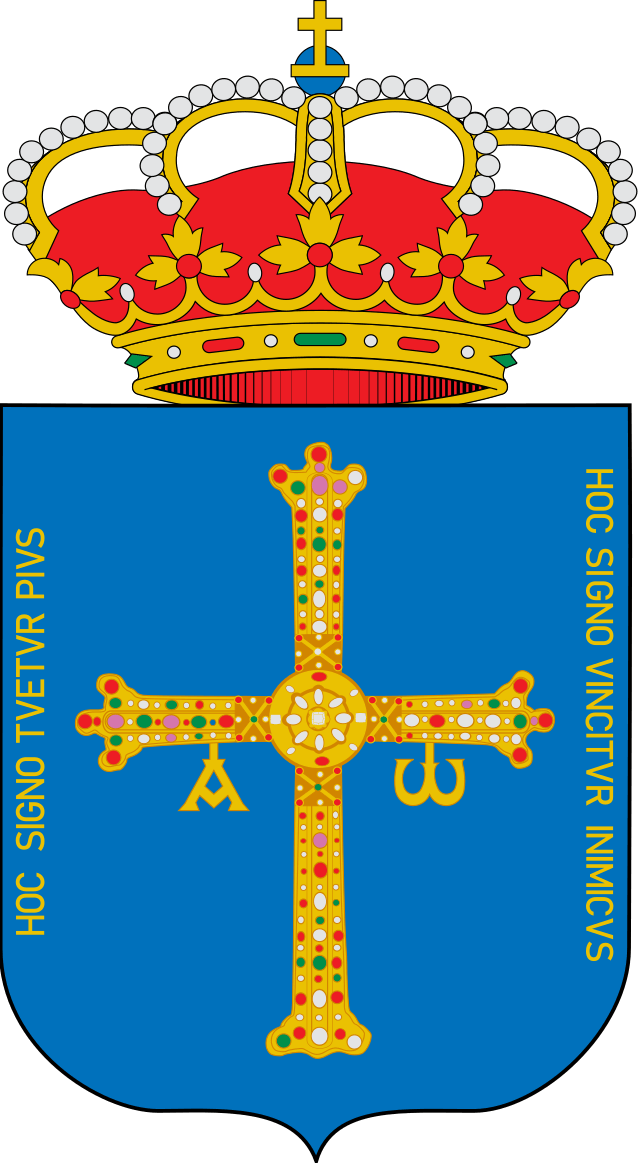
Coat of Arms of Principado de Asturias — the Cruz de la Victoria on azure, ensigned with a royal crown
Azure, the Cross of Victory Or, set with precious stones, between the letters Alpha and Omega Argent, and in base a royal crown Or.
The shield's blue (azure) field represents the sky and the Cantabrian Sea. At the centre stands the Cruz de la Victoria (Cross of Victory) in gold, adorned with precious stones and enamel — this is not a heraldic abstraction but a direct representation of the actual relic kept in the Cathedral of San Salvador de Oviedo. The Greek letters Alpha (Α) and Omega (Ω) hanging from the arms of the cross symbolise Christ as the beginning and the end, drawn from the Book of Revelation (22:13). At the base, a royal crown in gold recalls the dynastic continuity from the Kingdom of Asturias to the later kingdoms of León and Castile, and ultimately to modern Spain.
The origins of the coat of arms trace back to the Kingdom of Asturias (718–925), the first Christian political stronghold after the Umayyad conquest of 711. The Cross of Victory is traditionally associated with Pelayo, the Visigothic nobleman who led Christian forces at the Battle of Covadonga (722) — considered the symbolic starting point of the Reconquista. According to tradition, a wooden cross was carried by Pelayo during the battle. In the late 9th century, King Alfonso III had the cross encased in gold and set with precious stones, transforming it into both a religious relic and a royal emblem. It was formally incorporated into the coat of arms of the autonomous community after the approval of the Statute of Autonomy in 1981.
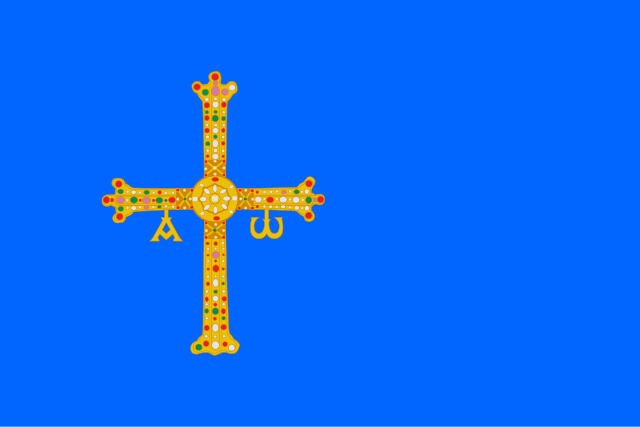
Flag of Principado de Asturias — blue field with the golden Cruz de la Victoria
The flag of Asturias displays a blue field bearing the golden Cruz de la Victoria slightly tilted, set with precious stones, with the letters Alpha and Omega in silver hanging from its arms. It is essentially the coat of arms placed directly on a blue ground, without additional framing. The tilted cross is a distinctive feature: the historical relic itself has a slight lean, and this detail was faithfully reproduced in the flag.
The blue represents both the sky and the Cantabrian Sea that borders the region to the north. The flag was adopted alongside the Statute of Autonomy in 1981.
The flag is flown at official buildings throughout the region and is one of the most historically charged regional flags in Spain, directly evoking the very origins of the Spanish state.
The symbol is the Cruz de la Victoria (Cross of Victory), a golden cross decorated with precious stones, with the Greek letters Alpha and Omega hanging from its arms. The original relic is kept at the Cathedral of San Salvador de Oviedo.
The Cross of Victory symbolises Christian resistance during the Reconquista. According to tradition, a wooden cross was carried by Pelayo at the Battle of Covadonga (722). King Alfonso III later had it covered in gold and precious stones, creating the relic venerated today.
Pelayo was the first king of the Kingdom of Asturias. He led Christian forces at the Battle of Covadonga in 722, traditionally considered the starting point of the Reconquista — the centuries-long campaign to retake the Iberian Peninsula from Umayyad rule.
Azure, the Cross of Victory Or, set with precious stones, between the letters Alpha and Omega Argent, and in base a royal crown Or. The blue field represents the sky and the Cantabrian Sea.
The Principado de Asturias became an autonomous community of Spain in 1981, with its Statute of Autonomy approved on 30 December 1981. It is one of the seventeen autonomous communities of the Kingdom of Spain.
Last reviewed by the Emblema Mundi editorial team on June 29, 2026.