Autonomous Community
Galicia is an autonomous community in the far north-west of the Iberian Peninsula, bordering Portugal to the south and the Atlantic Ocean to the west. Its four provinces — A Coruña, Lugo, Ourense, and Pontevedra — share a distinct Celtic heritage and a co-official language, Galician (galego). The region's most celebrated landmark is the Cathedral of Santiago de Compostela, the endpoint of the Camino de Santiago pilgrimage, and it is this deep religious identity that defines Galicia's coat of arms.
Flag
Not available
Coat of Arms
Not available
| Autonomous Community | Galicia (Galicia / Galiza) |
|---|---|
| Capital | Santiago de Compostela |
| Area | 29,574 km² |
| Co-official languages | Spanish, Galician |
| Statute of Autonomy | 1981 |
| Colors | Azure and white (flag); azure, gold and white (arms) |
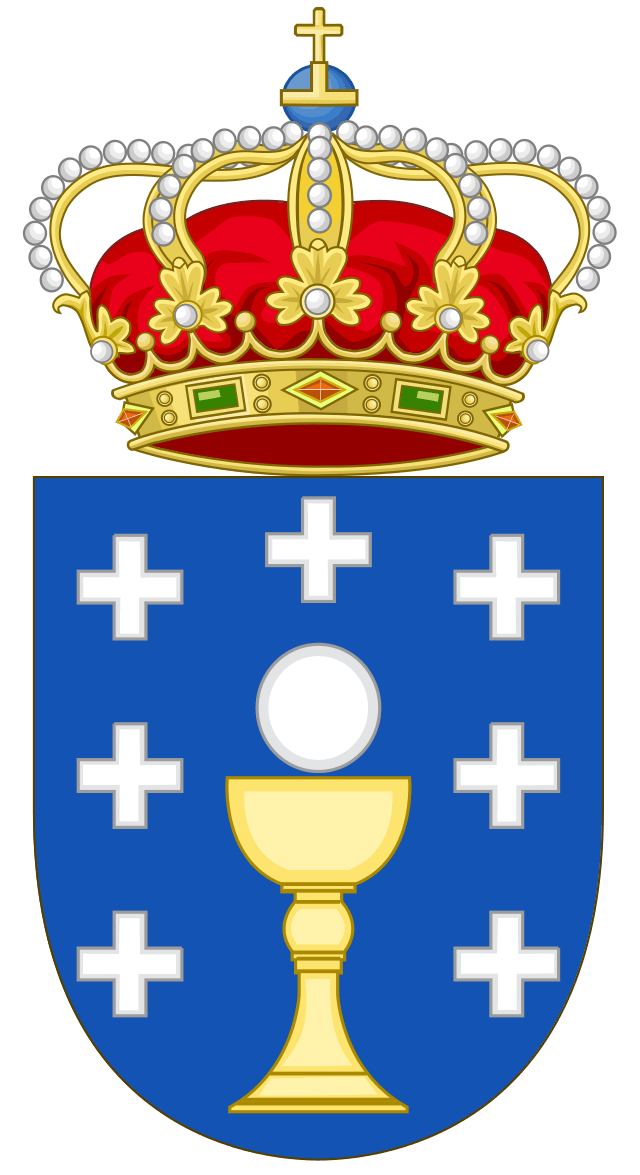
Coat of Arms of Galicia — chalice, host, and seven crosses on blue, officialized in 1981
Azure, a chalice Or surmounted by a host Argent, accompanied by seven crosses Argent.
The chalice-and-crosses design has deep medieval roots in Galicia, where the cult of St. James (Santiago) made the region one of the most important pilgrimage destinations in Christendom. The arms appear in various Galician institutional seals from the late Middle Ages onward. The current design was officialized by the Statute of Autonomy of Galicia in 1981, which established the autonomous community as one of Spain's historic nationalities.
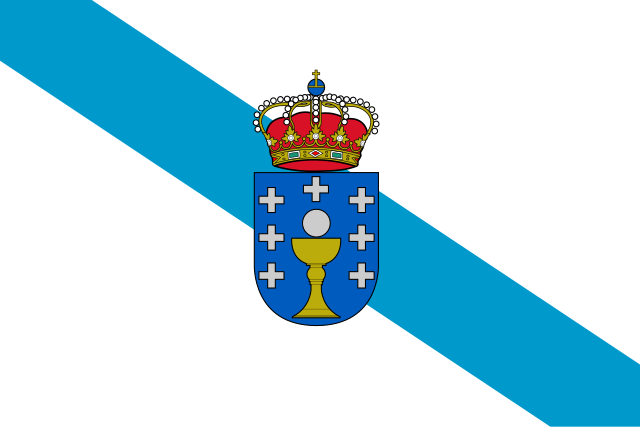
Flag of Galicia — Azure, a bend Argent, officialized in 1981
The flag of Galicia is heraldically described as Azure, a bend Argent — a blue field crossed by a white diagonal band running from the upper hoist to the lower fly.
Its origin is one of the more unusual stories in Spanish regional heraldry: in the 19th century, Galician emigrants departing from A Coruña mistakenly adopted the local harbour pilot's ensign (which had a white field with a blue diagonal) as a Galician regional banner. Over time the colours were inverted to give a blue field with a white band, and this design eventually became the official flag.
The flag was formalized by the Statute of Autonomy in 1981 and flies on all public buildings throughout the region.
A blue shield bearing a golden chalice surmounted by a silver host, accompanied by seven silver crosses. The design references the Eucharistic tradition of the region and the Cathedral of Santiago de Compostela.
The flag of Galicia is Azure, a bend Argent — a blue field crossed by a white diagonal band. It was officialized by the Statute of Autonomy of Galicia in 1981.
The flag originated from a 19th-century misunderstanding: emigrants departing via A Coruña adopted a local maritime ensign as a regional symbol, with the colours later reversed from white-with-blue-band to blue-with-white-band before being officially adopted.
The seven silver crosses surrounding the chalice are traditionally associated with the seven historical provinces of Galicia or with the processional crosses of the region's parishes, reinforcing its strong Catholic and pilgrimage identity.
Both the coat of arms and the flag of Galicia were officialized by the Statute of Autonomy of Galicia (Estatuto de Autonomía de Galicia) in 1981.
Last reviewed by the Emblema Mundi editorial team on June 29, 2026.