Autonomous Community
Extremadura is an autonomous community in western Spain bordering Portugal, comprising the provinces of Cáceres and Badajoz. Its history is shaped by the medieval Reconquista, the Military Orders of Alcántara and Calatrava, and above all by the extraordinary number of conquistadors born in its towns — among them Hernán Cortés (Medellín) and Francisco Pizarro (Trujillo). The coat of arms and flag both draw on this layered past, from the medieval kingdoms of Castile and León to the Spanish conquest of the Americas.
Flag
Not available
Coat of Arms
Not available
| Autonomous Community | Extremadura |
|---|---|
| Capital | Mérida |
| Area | 41,634 km² |
| Official language | Spanish |
| Statute of Autonomy | 1983 |
| Coat of Arms adopted | Law 4/1985 |
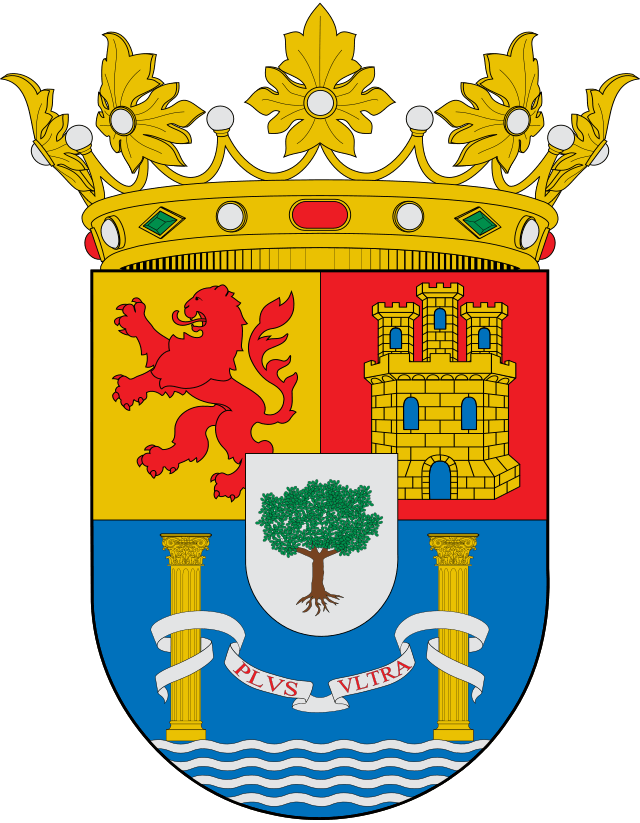
Coat of Arms of Extremadura — Castile, León, and the Pillars of Hercules with PLUS ULTRA, officialized by Law 4/1985
Quarterly: first, Gules a castle Or masoned Sable ajouré Azure; second, Argent a lion rampant purpure crowned langued and armed Gules; in base Sinople two columns Argent issuant from waves Azure and Argent, bound by a ribbon Gules inscribed PLUS ULTRA Or. Bordered Or charged with eight saltires Gules. Ensigned with a royal crown closed.
Extremadura was reconquered from Moorish rule in the 12th and 13th centuries largely through the efforts of the Military Orders of Alcántara and Calatrava, which held vast territories in the region. Politically, the area fell under the joint crowns of Castile and León, whose arms form the upper quarters of the shield. The most distinctive element — the Pillars of Hercules with PLUS ULTRA — was chosen to honor Extremadura's unparalleled contribution to the Spanish conquest of the Americas. The coat of arms was formalized by Law 4/1985 of the Junta de Extremadura.
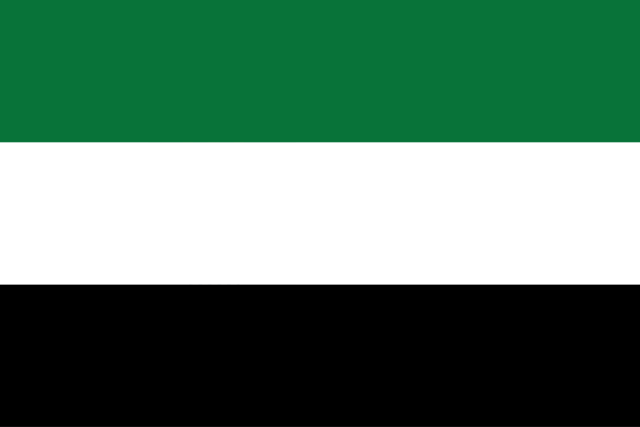
Flag of Extremadura — green, white, and black stripes with the coat of arms
The flag of Extremadura consists of three equal horizontal stripes — green at the top, white in the middle, and black at the bottom — with the coat of arms centered on the white stripe.
The colors are traditionally interpreted as references to the Military Orders that reconquered the region: green for the Order of Alcántara and black for the Order of Calatrava, with white representing their union.
The flag was officialized by the Statute of Autonomy in 1983 and further defined by Law 4/1985.
It combines the arms of Castile (gold castle on red) and León (purple lion on silver) with a green base bearing two silver Pillars of Hercules and the motto PLUS ULTRA, evoking Extremadura as the birthplace of many Spanish conquistadors including Hernán Cortés and Francisco Pizarro.
Green, white, and black are traditionally linked to the Military Orders of Alcántara (green) and Calatrava (black), which drove the Reconquista in the region, with white symbolizing their union.
The two silver Pillars of Hercules rising from waves, bound by a ribbon reading PLUS ULTRA, reference the Atlantic gateway and Extremadura's role in producing conquistadors who expanded Spain's empire beyond the classical world's limits.
The coat of arms was officialized by Law 4/1985 of the Junta de Extremadura.
Quarterly: first, Gules a castle Or masoned Sable ajouré Azure (Castile); second, Argent a lion rampant purpure crowned langued and armed Gules (León); in base Sinople two columns Argent issuant from waves, bound by a ribbon Gules inscribed PLUS ULTRA Or. Bordered Or charged with eight saltires Gules. Ensigned with a royal crown closed.
Last reviewed by the Emblema Mundi editorial team on June 29, 2026.