Autonomous Community
Comunitat Valenciana (Valencian Community) is an autonomous community on the eastern Mediterranean coast of Spain, comprising the provinces of Alacant, Castelló and València. Its heraldic identity stems from the medieval Kingdom of Valencia, founded in 1238 when Jaume I of Aragó conquered the city of València and established a separate realm within the Crown of Aragó. The Senyera Coronada — the "crowned banner" — remains one of the most historically layered flags in Spain.
Flag
Not available
Coat of Arms
Not available
| Autonomous Community | Comunitat Valenciana |
|---|---|
| Capital | València |
| Co-official languages | Spanish, Valencian |
| Area | 23,255 km² |
| Statute of Autonomy | 1982 |
| Flag adopted | Statute of Autonomy 1982 |
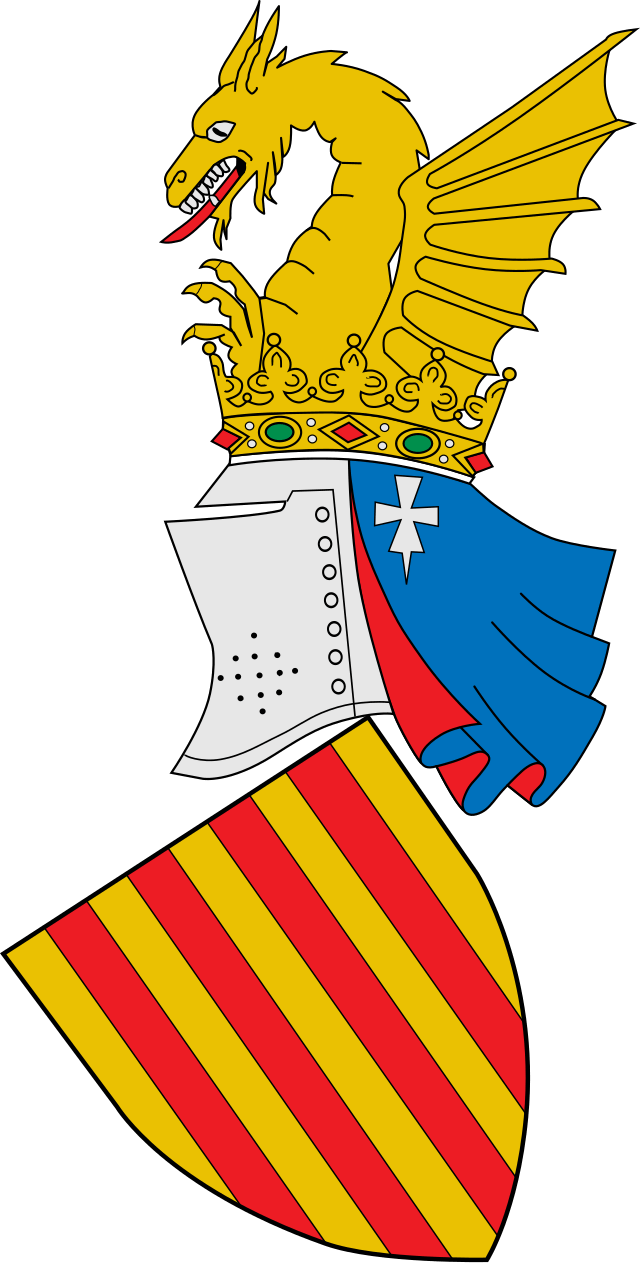
Coat of Arms of Comunitat Valenciana — the Senyera Coronada, four red pales on gold with royal crown
Or, four pales Gules; ensigned with a royal crown closed.
When Jaume I conquered València in 1238, he established the Kingdom of Valencia as a distinct entity under the Crown of Aragó, with its own furs (laws) and institutions. The four red bars on gold were immediately adopted as the arms of the new kingdom, directly derived from the royal arms of Aragó. Pere IV (el Cerimoniós) further distinguished Valencia's heraldry in 1377 by conferring the royal crown upon the kingdom's banner. The arms were officially codified as those of the autonomous community by the Statute of Autonomy of 1982 (reformed in 2006).
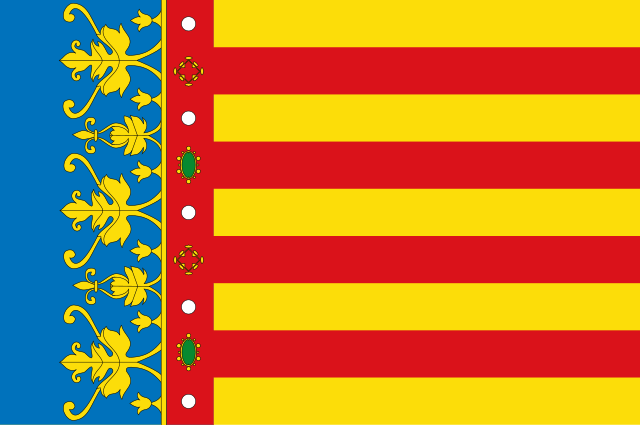
Flag of Comunitat Valenciana — the Reial Senyera, Senyera with blue hoist band and royal crown
The flag of Comunitat Valenciana, known as the Senyera Coronada or Reial Senyera, consists of four horizontal red bars on a gold field — the Senyera shared with the other territories of the former Crown of Aragó. Its distinguishing feature is a vertical blue (azure) band edged in gold along the hoist, charged with the royal crown.
This blue band with crown was added to commemorate the royal privilege granted by Pere IV in 1377, which elevated the city banner of València to a royal ensign.
The flag was formally adopted by the Statute of Autonomy in 1982 and flies on all official buildings of the autonomous community.
The coat of arms is the Senyera Coronada: a shield bearing four red pales on a gold field — the arms of the Crown of Aragó — ensigned with a closed royal crown. It commemorates the Kingdom of Valencia established by Jaume I in 1238.
The vertical blue band along the hoist distinguishes the Valencian flag from other Senyera-derived flags. It is charged with a royal crown and commemorates the conferral of royal status upon the city banner of València by Pere IV in 1377.
Jaume I of Aragó conquered València in 1238 and established the Kingdom of Valencia, adopting the four red bars on gold of the Crown of Aragó as its heraldic arms.
The Senyera Coronada was officialized as the flag of the Autonomous Community of Valenciana by the Statute of Autonomy in 1982.
The blazon reads: Or, four pales Gules — four red vertical stripes on a gold field — ensigned with a closed royal crown. This is the classic blazon of the Crown of Aragó, distinguished by the addition of the royal crown.
Last reviewed by the Emblema Mundi editorial team on June 29, 2026.