Autonomous Community
The Comunidad de Madrid is the autonomous community surrounding and including Spain's capital city, Madrid. It is a unique single-province community, constituted in 1983 when the decision was taken not to merge Madrid into Castilla y León. Its coat of arms and flag carry the seven stars of Ursa Major — a constellation associated with Madrid since the medieval period — on a field of azure and crimson respectively, colors linked to the city's Castilian heritage and the Comunero rebellion of the early 16th century.
Flag
Not available
Coat of Arms
Not available
| Status | Autonomous Community of Spain |
|---|---|
| Capital | Madrid |
| Provinces | 1 (Madrid) |
| Statute of Autonomy | 25 February 1983 |
| Arms and flag adopted | Law 2/1983 |
| Heraldic symbol | Seven stars of Ursa Major on azure |
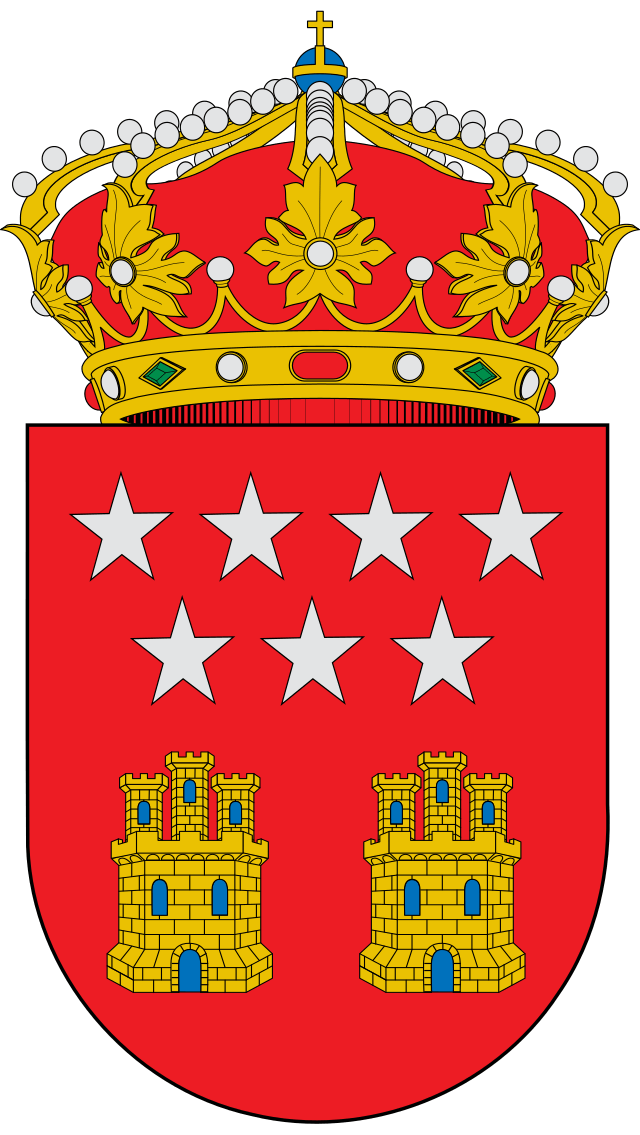
Coat of Arms of Comunidad de Madrid — seven stars of Ursa Major on azure, adopted by Law 2/1983
Azure, seven mullets of five points argent arranged 4-3. Ensigned with a closed royal crown.
The coat of arms of the Community of Madrid shows a blue (azure) field charged with seven five-pointed silver stars arranged in two rows of four and three. The pattern reproduces the asterism of Ursa Major (the Plough or Big Dipper), which has been the traditional emblem of the city of Madrid since at least the 15th century. The shield is ensigned with a closed royal crown. The simplicity of the design — stars on blue — gives the arms a distinctive, immediately legible character.
The seven stars of Ursa Major have been associated with Madrid since the medieval period; they appear in the city's heraldic tradition long before the Comunidad was created. When the autonomous community was constituted in 1983, it adopted this established symbol rather than inventing new arms. The stars also evoke the night sky over the Castilian plateau. The arms were formally adopted by Law 2/1983. The community was deliberately kept distinct from Castilla y León despite its Castilian heritage, making it Spain's only single-province autonomous community centered entirely on a capital city.
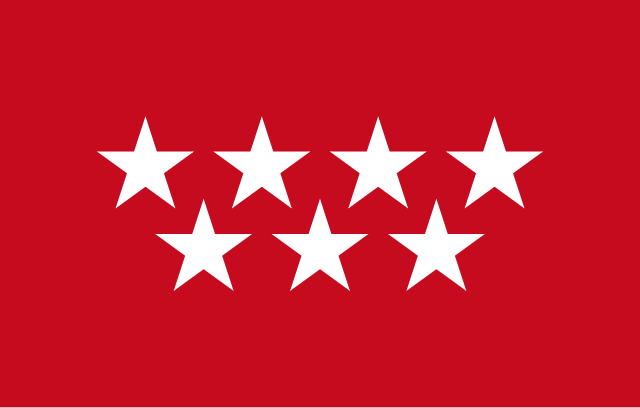
Flag of Comunidad de Madrid — seven silver stars on crimson, officialized by Law 2/1983
The flag of the Community of Madrid is a crimson (carmesí) field charged with the seven five-pointed silver stars arranged 4-3 in the pattern of Ursa Major.
The crimson color is deeply Castilian: it recalls the Comunero uprising of 1520–1521, when the cities of Castile — including Madrid — rose against the centralizing policies of Carlos I. The seven stars on the flag directly correspond to those in the coat of arms.
The flag was officialized by Law 2/1983, alongside the arms. Today it flies on all public buildings of the autonomous community, a bold visual distinction from the more complex flags of neighboring regions.
The seven silver stars represent the constellation Ursa Major (the Plough or Big Dipper). The city of Madrid has used this constellation as its emblem since the medieval period.
The flag is a crimson field charged with seven five-pointed silver stars arranged 4-3, mirroring Ursa Major. It was officialized by Law 2/1983.
Crimson recalls the Comunero uprising of 1520–1521, a revolt of Castilian cities — including Madrid — against Carlos I. The color is strongly associated with Castilian civic tradition.
The Comunidad de Madrid was constituted as an autonomous community on 25 February 1983. It is Spain's only single-province autonomous community centered entirely on a capital city.
No. The city of Madrid uses a bear and strawberry tree (madroño) as its emblem. The Comunidad de Madrid uses seven stars of Ursa Major on azure as its regional arms.
Last reviewed by the Emblema Mundi editorial team on June 29, 2026.