Autonomous Community
Cataluña (Catalan: Catalunya) is an autonomous community of northeastern Spain with its own language, culture, and a heraldic identity that predates the formation of modern Spain by several centuries. Its flag — the Senyera — and coat of arms, both bearing the four red bars on gold, are among the oldest continuously used emblems in Europe, rooted in the medieval Crown of Aragón and the Counts of Barcelona.
Flag
Not available
Coat of Arms
Not available
| Status | Autonomous Community of Spain |
|---|---|
| Capital | Barcelona |
| Official languages | Catalan, Spanish, Aranese (Occitan) |
| Statute of Autonomy | 1979 (restored); 2006 (revised) |
| Arms and flag adopted | Law 1/1981 |
| Heraldic tradition | Four bars documented from the 12th century |
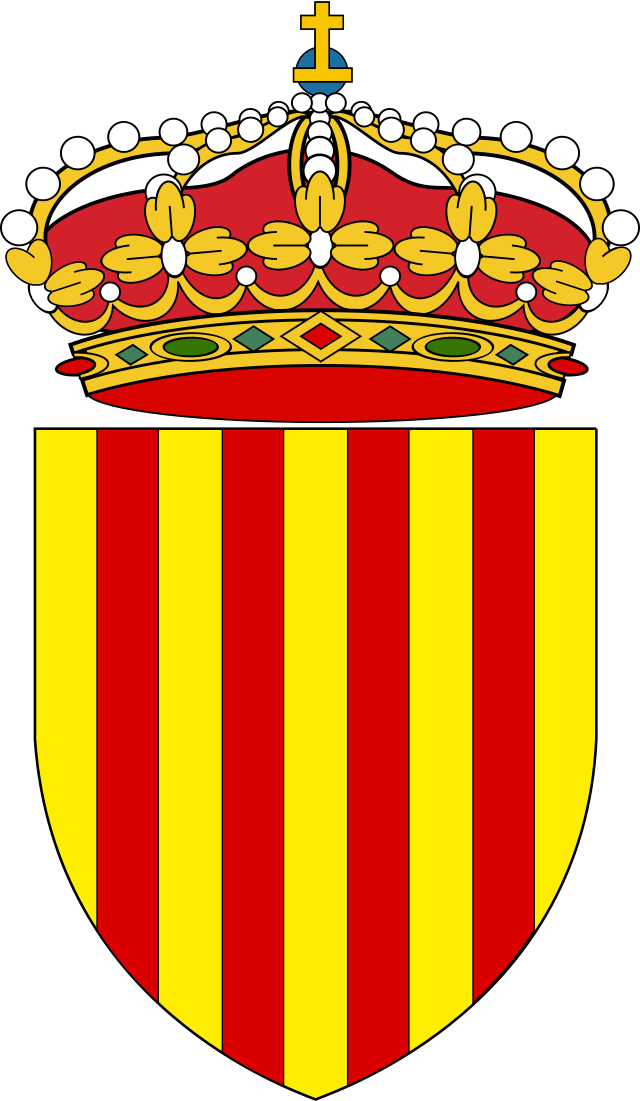
Coat of Arms of Cataluña — the four bars of the Crown of Aragón, adopted by Law 1/1981
Or, four pales gules. Ensigned with a closed royal crown.
The coat of arms of Catalonia is a gold shield charged with four vertical red stripes (pales), known as the barres de Catalunya or the four bars. These are the historical arms of the Crown of Aragón and of the Counts of Barcelona. The shield is ensigned with a closed royal crown, signaling the autonomous community's status within the Spanish constitutional monarchy. The design is one of the simplest and most ancient in Iberian heraldry.
The four bars appear reliably documented from the 12th century on the seal of Ramon Berenguer IV, Count of Barcelona. A popular legend attributes their origin to Wilfred the Hairy (Guifré el Pilós), Count of Barcelona, and the Frankish king Charles the Bald, who supposedly drew four bloody fingers across a golden shield — but heraldic science finds no evidence predating the 12th century. The arms were shared across the Crown of Aragón and were formally adopted for Catalonia by Law 1/1981, following the restoration of the Statute of Autonomy of 1979.
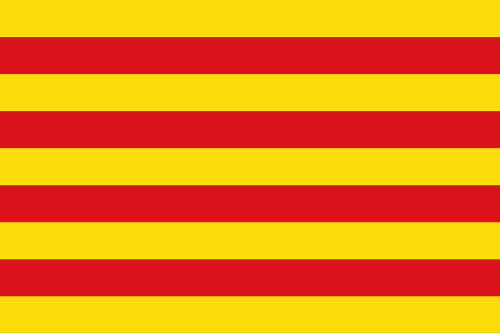
Flag of Cataluña — the Senyera, four red stripes on gold, codified by Law 1/1981
The flag of Catalonia is known as the Senyera (the signal or banner). It consists of nine horizontal stripes of equal width — five gold and four red — the four red stripes being the direct translation of the heraldic four bars into flag form.
The Senyera is one of the oldest documented flags in Europe, with manuscript evidence going back to the 13th century. It was officially adopted as the flag of Catalonia by the Statute of Autonomy of 1979 and codified by Law 1/1981.
The Senyera should not be confused with the Estelada, an unofficial independence symbol that adds a triangle and star. Only the Senyera has official legal status as the flag of the autonomous community.
The Senyera is the official flag of Catalonia: four red horizontal stripes on a gold field (nine equal stripes total). It is one of the oldest flags in Europe and derives from the heraldic arms of the medieval Counts of Barcelona.
The four red bars (barres de Catalunya) on gold are the historical arms of the Crown of Aragón, documented from the 12th century on the seal of Ramon Berenguer IV. The popular legend linking them to Wilfred the Hairy is not historically confirmed.
The coat of arms was officially adopted by Law 1/1981 of the Generalitat de Catalunya, following the restoration of the Statute of Autonomy of 1979.
No. The Senyera is the official flag: four red stripes on gold. The Estelada is an unofficial symbol adding a blue triangle and white star, associated with the Catalan independence movement. Only the Senyera has official legal status.
Cataluña has three official languages: Catalan (the co-official and historically primary language), Spanish, and Aranese (a variety of Occitan spoken in the Val d'Aran). Catalan is also co-official in the Balearic Islands and the Valencian Community.
Last reviewed by the Emblema Mundi editorial team on June 29, 2026.