Autonomous Community
Castilla y León is the largest autonomous community of Spain and the European Union by surface area, stretching across the northern Meseta. It encompasses nine provinces — Ávila, Burgos, León, Palencia, Salamanca, Segovia, Soria, Valladolid, and Zamora — and unites the territories of two medieval kingdoms whose heraldic legacy remains one of the most recognizable in all of Iberia: the gold castle of Castile and the purple lion of León.
Flag
Not available
Coat of Arms
Not available
| Status | Autonomous Community of Spain |
|---|---|
| Capital | Valladolid (seat of government) |
| Provinces | 9 (Ávila, Burgos, León, Palencia, Salamanca, Segovia, Soria, Valladolid, Zamora) |
| Statute of Autonomy | 1983 |
| Arms adopted | Law 1/1991 |
| Heraldic tradition | Combined arms of Castile and León since 1230 |
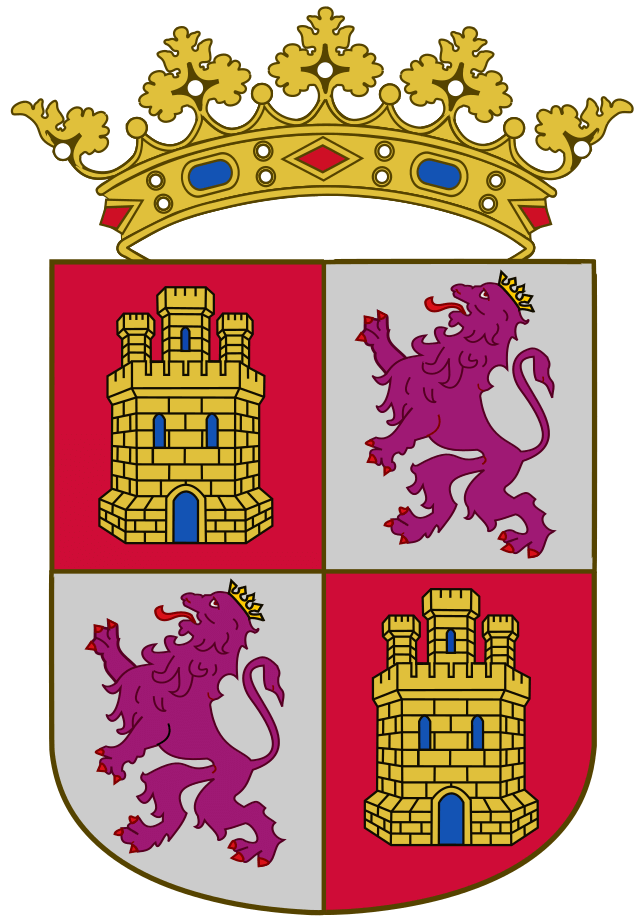
Coat of Arms of Castilla y León — quarterly castle and lion, adopted by Law 1/1991
Quarterly: first and fourth, gules a triple-towered castle or, masoned sable, windows and port azure; second and third, argent a lion rampant purpure, crowned, langued and armed gules. Ensigned with a closed royal crown.
The shield is divided into four quarters. The first and fourth (Castile) show a gold triple-towered castle on red — the canting arms for the Kingdom of Castile (castillo = castle). The second and third (León) show a purple lion rampant, crowned and armed in gules, on white — the lion being the ancient emblem of the Kingdom of León. The closed royal crown signals the autonomous community's status within the Spanish constitutional monarchy.
The quartered arms of Castile and León entered royal use when Fernando III definitively united the two crowns in 1230. They served as the arms of the Crown of Castile and subsequently of unified Spain until the union with Aragón. The autonomous community, created in 1983, formally adopted these combined arms — the most direct heraldic descendant of medieval Castilian-Leonese tradition — by Law 1/1991. Remarkably, the use of purple (purpure) for the lion is one of the rarest tinctures in European heraldry, making the Leonese arms immediately distinctive.
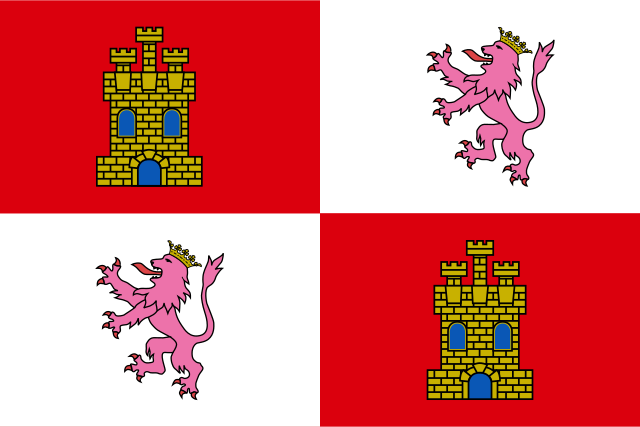
Flag of Castilla y León — quartered banner, officialized in 1983
The flag of Castilla y León is the direct heraldic translation of the coat of arms into banner form. It is quartered: the first and fourth quarters repeat the Castilian arms — a gold three-towered castle on red; the second and third repeat the Leonese arms — a purple crowned lion rampant on white.
This design was established by the Statute of Autonomy in 1983. The approach of directly converting the shield into a flag is a tradition shared by several Spanish autonomous communities, making the flag immediately legible to anyone familiar with the heraldry.
The flag flies on all public buildings of the autonomous community, alongside the national flag of Spain and the flag of the European Union.
It combines the historical arms of two medieval kingdoms: the gold castle of Castile on red, and the purple crowned lion of León on white, united since Fernando III joined the two crowns in 1230.
The current form was adopted by Law 1/1991, though the heraldic tradition dates to the 13th century.
A quartered banner mirroring the shield: castle on red in quarters one and four, lion on white in quarters two and three. Officialized by the Statute of Autonomy in 1983.
Purple (purpure) is one of the rarest tinctures in European heraldry. The Leonese lion has been purple since the medieval arms of the Kingdom of León, making it instantly recognizable.
Castilla y León, with nine provinces and over 94,000 km², is the largest autonomous community in Spain and in the European Union.
Last reviewed by the Emblema Mundi editorial team on June 29, 2026.