Autonomous Community
Castilla-La Mancha is a large autonomous community of central-southern Spain, occupying the high plateau of the Meseta Central south of Madrid. The heartland of medieval Castile, the region includes the ancient cities of Toledo (former Visigothic and early medieval capital of Iberia), Cuenca, and Guadalajara. Its vast flat landscapes of windmills, vineyards and olive groves are immortalised in Miguel de Cervantes' Don Quixote de la Mancha (1605), the most widely translated work in the Spanish language. The autonomous community was established in 1982, and its heraldry distils its identity to its essence: the golden castle of medieval Castile on red and the open white plain of La Mancha.
Flag
Not available
Coat of Arms
Not available
| Autonomous Community | Castilla-La Mancha |
|---|---|
| Capital | Toledo |
| Coat of Arms adopted | 1983 (Law 1/1983) |
| Flag adopted | 1982 (Statute of Autonomy) |
| Colors | Red, white, gold |
| Location | Central-southern Spain, south of Madrid |
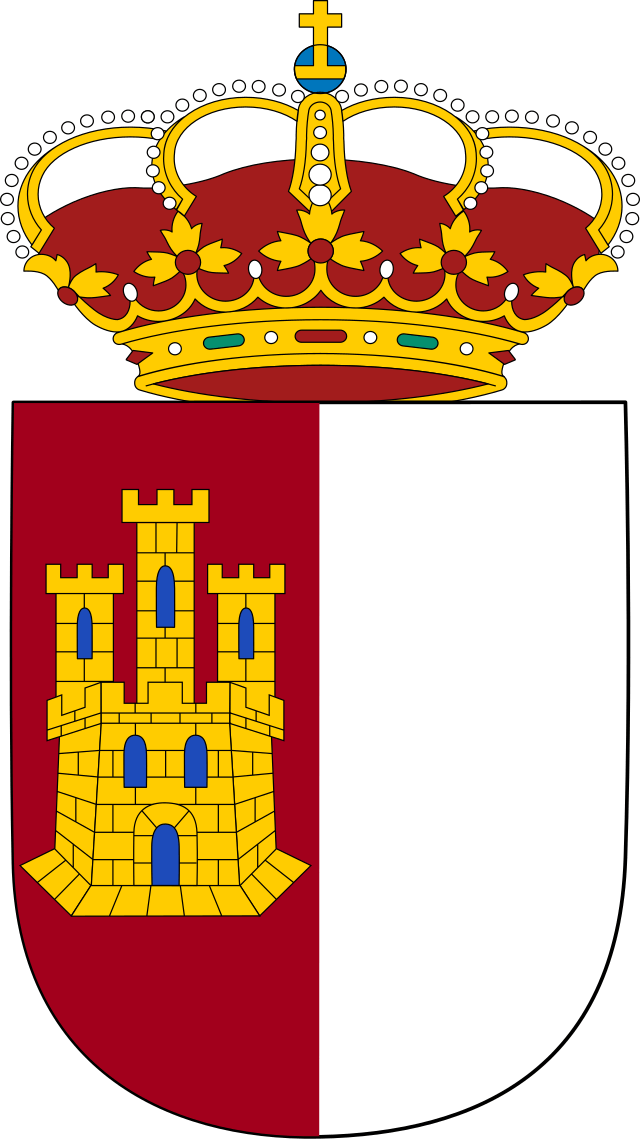
Coat of Arms of Castilla-La Mancha — Gold castle of Castile on gules over plain silver; adopted by Law 1/1983
Per fess. Upper half: gules, a castle or triple-towered, masoned sable, windows and door azure (Kingdom of Castile). Lower half: argent, plain. Ensigned with a closed royal crown.
The golden castle of Castile is one of the oldest and most recognized heraldic symbols of the Iberian Peninsula. It appears in the royal arms of Alfonso VIII de Castilla (r. 1158–1214) and has been used continuously ever since, appearing in the national coat of arms of Spain to this day. The name Castilla itself is commonly derived from the Latin castella (castles), referring to the many fortresses built during the Reconquista. The autonomous community's coat of arms was formalized by Law 1/1983 of the Cortes de Castilla-La Mancha, adopting the bipartite design that mirrors the flag.
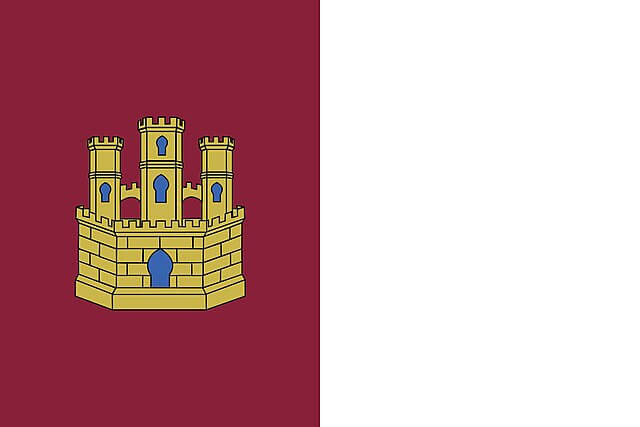
Flag of Castilla-La Mancha — Red with gold castle and plain white, vertical bicolor adopted in 1982
The flag of Castilla-La Mancha has two equal vertical stripes: the hoist (left side) is red charged with a gold three-towered castle, while the fly (right side) is plain white. The design is a direct vertical rendering of the coat of arms, making the flag one of the most straightforward heraldic translations in Spain.
The flag design flows directly from the coat of arms, which draws on the medieval arms of the Kingdom of Castile. The Statute of Autonomy of Castilla-La Mancha, adopted in 1982, established the bicolor vertical flag as the official regional flag, with the coat of arms adopted the following year by Law 1/1983.
The flag of Castilla-La Mancha flies on all public buildings of the autonomous community. Its bold bicolor design is among the most recognisable of the Spanish regional flags, directly evoking the historic arms of Castile. The region's literary association with Don Quixote makes the windmill landscapes of La Mancha — visible beneath this flag — among the most iconic in Spanish culture.
The gold three-towered castle on a red field is the historical coat of arms of the Kingdom of Castile, first documented under Alfonso VIII de Castilla in the 12th century. It symbolises the Castilian heritage of the region and appears identically in the national coat of arms of Spain.
La Mancha is the name of the southern plateau of the community. The word likely derives from the Arabic al-Mansha (dry land, high plateau) or from Mancha (stain, plain in old Castilian). The white lower half of the shield evokes this open, flat landscape.
Yes. Miguel de Cervantes set Don Quixote de la Mancha (1605–1615) in the plains of La Mancha, and the windmills Don Quixote famously charged as giants are still standing in Campo de Criptana and Consuegra. Toledo, the regional capital, is also closely associated with Cervantes.
The name Castilla is traditionally derived from the Latin castella (castles), referring to the fortresses built during the Christian Reconquista of the Iberian Peninsula. The region's landscape was once dotted with castles built to defend the advancing frontier against Moorish territories.
The coat of arms was adopted by Law 1/1983 of the Cortes de Castilla-La Mancha. The flag was established by the Statute of Autonomy in 1982.
Last reviewed by the Emblema Mundi editorial team on June 29, 2026.