Autonomous Community
Cantabria is a small autonomous community on the northern coast of Spain, facing the Bay of Biscay. It takes its name from the ancient Cantabri, a pre-Roman people famed for their fierce resistance against Roman conquest in the Cantabrian Wars (29–19 BC) — one of the most prolonged military campaigns of the Augustan age. The region's maritime heritage is as old as its warrior past: the port of Santander was a major hub for Atlantic trade and the wool exports of Castile. Cantabria gained autonomous status in 1981 as a uniprovincial community, and its symbols deliberately weave together both strands of its identity — the ancient Cantabrian stele of its indigenous peoples and the ship and tower of its maritime history.
Flag
Not available
Coat of Arms
Not available
| Autonomous Community | Cantabria |
|---|---|
| Capital | Santander |
| Coat of Arms adopted | 1981 (Law of 30 December 1981) |
| Flag adopted | 1981 (Statute of Autonomy) |
| Colors | White and red |
| Location | Northern Spain, Bay of Biscay coast |
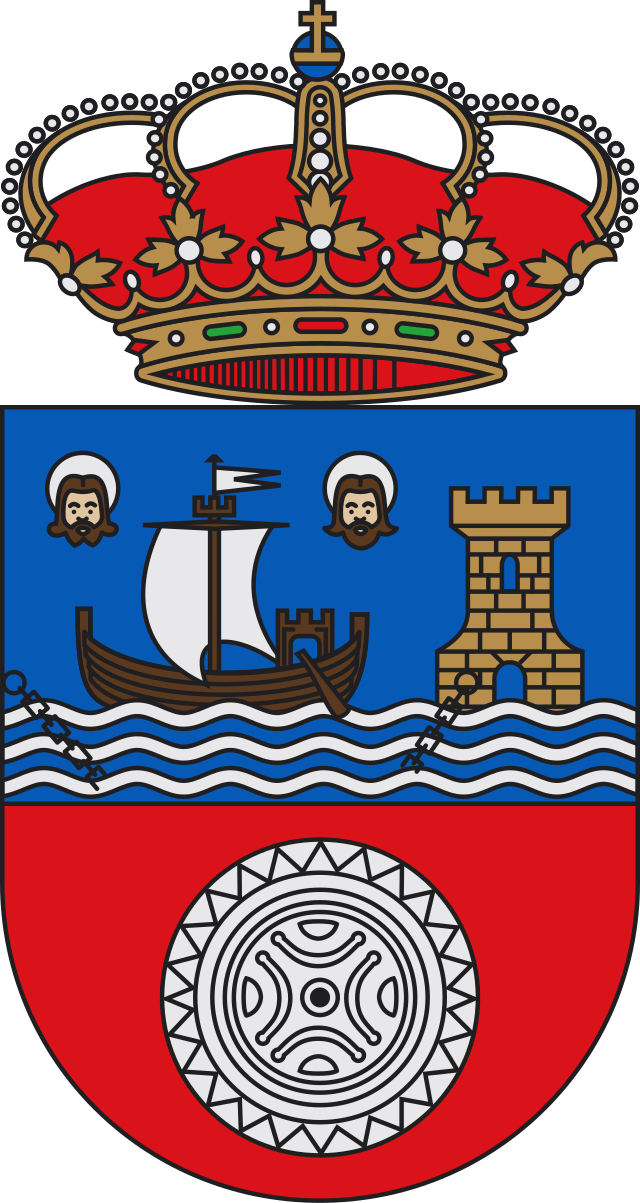
Coat of Arms of Cantabria — Tower, ship breaking a chain, and Cantabrian stele; adopted 30 December 1981
Party per fess. Upper half, azure: a golden crenellated tower masoned, port and windows azure; to its right a ship in natural colours whose bow has broken a black chain stretching from the tower to the dexter flank; at the base, sea waves argent and azure; in chief two haloed severed male heads. Lower half, gules: a disc-shaped stele with geometric ornaments in the style of the Cantabrian steles of Barros or Lombera. Ensigned with a closed royal crown.
The imagery of the tower and ship derives from the maritime heritage of Santander, whose port was established as one of the key Atlantic harbors of medieval Castile. The ship registration flag of the province of Santander, established by Royal Order on 30 July 1845, introduced the white-over-red bicolor that became the basis of the modern regional flag. The Cantabrian stele was incorporated into the coat of arms as a symbol of pre-Roman indigenous identity. The current coat of arms was formally established by a law of the Regional Assembly of Cantabria on 30 December 1981.
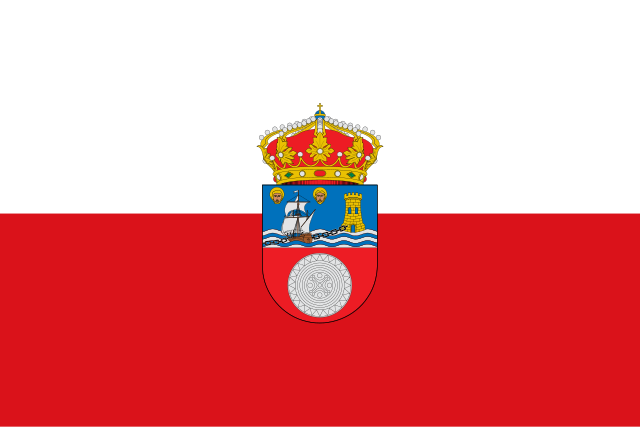
Flag of Cantabria — White over red bicolor, derived from the 1845 maritime province flag
The flag of Cantabria has two equal horizontal stripes, white on top and red below, with the coat of arms centered on the flag. The bicolor design directly descends from the historic ship registration flag of the maritime province of Santander.
The white-and-red design was first used officially as the registration flag of the maritime province of Santander, assigned by Royal Order on 30 July 1845. This pre-autonomy origin gives the flag one of the most historically grounded lineages among the regional flags of Spain. The coat of arms element was established by the Regional Assembly on 30 December 1981, and the full flag was included in the Statute of Autonomy of Cantabria.
The flag of Cantabria flies on all official regional buildings. Its white-and-red bicolor, derived from the historic maritime province, gives Cantabria a visual distinctiveness that reflects its seafaring past. The flag is frequently displayed alongside the Spanish national flag and the European Union flag on public buildings.
The ship breaking a chain symbolises the seafaring tradition of Cantabria and the freedom of navigation. The port of Santander was a major hub of Atlantic trade in medieval and early modern Castile, and the ship reflects this deep maritime heritage.
Cantabrian steles are disc-shaped stone funerary monuments decorated with geometric patterns, typical of the pre-Roman Cantabri people of the Iron Age. Examples from Barros and Lombera are among the most celebrated. The stele on the coat of arms connects modern Cantabria to its ancient indigenous identity.
The white and red derive from the ship registration flag of the historical maritime province of Santander, established by Royal Order on 30 July 1845, giving Cantabria's colors one of the most historically documented origins among Spain's regional flags.
The Cantabri were a pre-Roman people inhabiting the mountains and coast of northern Iberia. They resisted Roman conquest in the Cantabrian Wars (29–19 BC), one of the hardest campaigns of Emperor Augustus. Their name survives in that of the modern autonomous community and its mountain range, the Cordillera Cantábrica.
The coat of arms was established by a law of the Regional Assembly of Cantabria approved on 30 December 1981, and was incorporated into the Statute of Autonomy of Cantabria.
Last reviewed by the Emblema Mundi editorial team on June 29, 2026.