Autonomous Community
Canarias (the Canary Islands) is a Spanish autonomous community composed of seven main islands in the Atlantic Ocean, roughly 100 km off the northwest coast of Africa. Known to classical authors as the Insulae Fortunatae (the Fortunate Isles), the archipelago was gradually conquered by Castile between 1402 and 1496, completing the Castilian expansion just before Columbus set sail from La Gomera in 1492. The islands' unique volcanic landscape, indigenous Guanche culture, and Atlantic location have long shaped their identity. Canarias became an autonomous community with the Statute of Autonomy of 1982. Its coat of arms, with seven silver islands on azure and golden hound supporters, is one of the most distinctive in Spain.

Flag
Not available
Coat of Arms
Not available
| Autonomous Community | Canarias |
|---|---|
| Capital | Las Palmas de Gran Canaria / Santa Cruz de Tenerife (co-capitals) |
| Coat of Arms adopted | 1991 (Law 7/1991) |
| Flag adopted | 1982 (Statute of Autonomy) |
| Colors | White, blue, yellow (flag); azure and silver (arms) |
| Location | Atlantic Ocean, off the northwest coast of Africa |
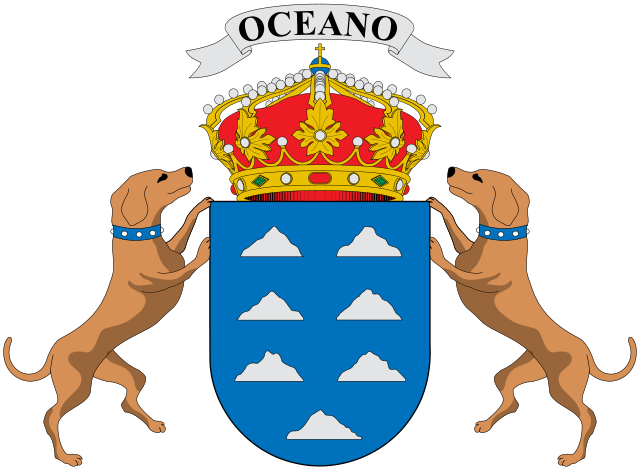
Coat of Arms of Canarias — Seven silver islands on azure, golden hound supporters, motto OCÉANO
Azure, seven islands argent arranged 3-1-3. Supported by two golden hounds rampant. Ensigned with a Spanish royal crown. On a scroll below, the motto OCÉANO.
Early heraldic symbols for the Canary Islands drew on Castilian conquest imagery. The characteristic design featuring seven islands as stylised landmasses on azure was developed in the 20th century to unify the two historically rival provincial capitals — Las Palmas de Gran Canaria and Santa Cruz de Tenerife. The current coat of arms was formally adopted by Law 7/1991 of the Parliament of the Canary Islands, replacing earlier versions that had existed since the Statute of Autonomy.
Flag of Canarias — White, blue and yellow vertical tricolor, officialized in 1982
The flag of Canarias displays three equal vertical stripes of white, blue and yellow. The civil flag bears no coat of arms; the institutional version used by official bodies places the coat of arms in the center. The tricolor combines the traditional colors of the two main islands: white and blue for Tenerife, yellow and blue for Gran Canaria.
The combination of white, blue and yellow as Canarian colors developed in the 19th century through regional identity movements seeking a symbol distinct from the Spanish national flag. The design consciously merged the heraldic colors of the two provincial capitals to express archipelago unity. The flag was officialized with the Statute of Autonomy of 1982.
The flag of Canarias flies on all official buildings of the autonomous community and is displayed alongside the national Spanish flag and the European Union flag. Due to the islands' status as an EU Outermost Region, European symbols are particularly prominent in Canarias.
The two golden hounds reference the Latin name Insula Canaria (Island of Dogs), from canis (dog). Ancient navigators, likely Romans, reportedly found large dogs on the islands. The name stuck and eventually became the source for both the islands' name and the modern word "canary" (the bird, named after the islands, not the other way around).
They represent the seven inhabited islands of the archipelago: La Palma, Tenerife, La Gomera, El Hierro, Gran Canaria, Fuerteventura and Lanzarote. They are arranged 3-1-3 on a blue field representing the surrounding Atlantic Ocean.
OCÉANO (Ocean) emphasises the Atlantic identity of the Canary Islands, their geographic remoteness from mainland Spain, and their historic role as a gateway between Europe, Africa and the Americas.
Canarias has two co-capitals — Las Palmas de Gran Canaria and Santa Cruz de Tenerife — reflecting a centuries-old rivalry between the eastern and western island groups. Administrative functions are split between the two cities, a compromise enshrined in the 1982 Statute of Autonomy.
The flag was established by the Statute of Autonomy in 1982. The coat of arms in its current form was adopted by Law 7/1991 of the Canarian Parliament.
Last reviewed by the Emblema Mundi editorial team on June 29, 2026.