Autonomous Community
Aragón is an autonomous community of northeastern Spain, encompassing the valleys of the Pyrenees and the dry central plateau of the Ebro basin. One of the oldest political entities on the Iberian Peninsula, it traces its origins to the Kingdom of Aragón founded in the 9th century. Under Fernando II de Aragón, the Crown of Aragón merged with the Crown of Castile to form the basis of modern Spain. Aragón's heraldry is among the most historically significant in Europe: the four red bars on gold, documented as early as the 12th century, are considered one of the oldest continuously used heraldic symbols on the continent. The autonomous community was established by the Statute of Autonomy of Aragón in 1982.
Flag
Not available
Coat of Arms
Not available
| Autonomous Community | Aragón |
|---|---|
| Capital | Zaragoza |
| Coat of Arms adopted | 1984 (Law 2/1984) |
| Flag adopted | 1982 (Statute of Autonomy) |
| Colors | Gold and red |
| Location | Northeastern Spain, bordering France and Cataluña |
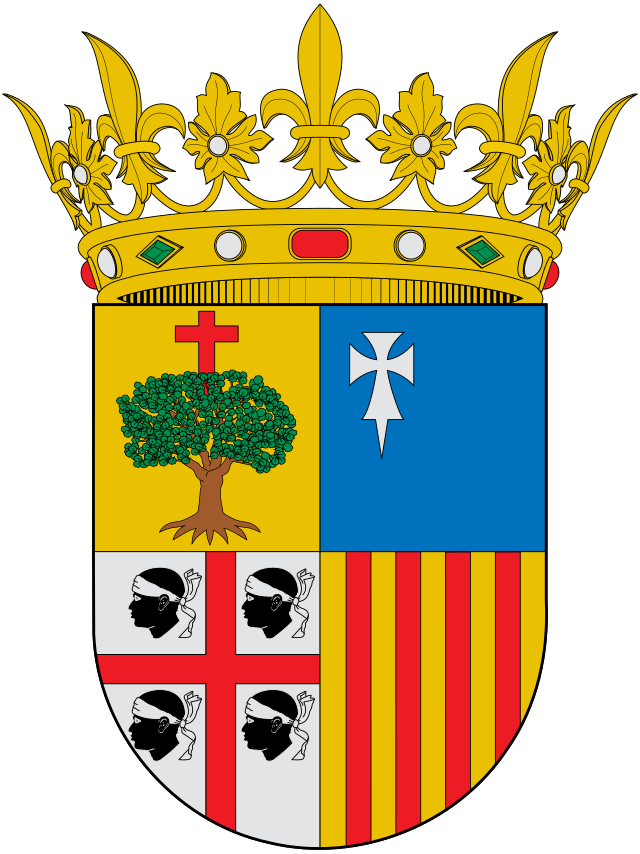
Coat of Arms of Aragón — Quartered shield: Sobrarbe, Íñigo Arista, Alcoraz, Señal Real
Quarterly: 1st, Or a green oak tree on a mount with a red cross surmounting (Sobrarbe); 2nd, Azure a white floriated cross (Íñigo Arista); 3rd, Argent a red cross of Saint George with four crowned Moors' heads in the cantons (Alcoraz); 4th, Or four pales gules (Señal Real). Ensigned with a closed royal crown.
The Señal Real of four red bars on gold is first documented in the seal of Ramón Berenguer IV, Count of Barcelona and Prince of Aragón, in the mid-12th century. It became the dominant arms of the entire Crown of Aragón, shared by Cataluña, Valencia and the Balearic Islands. The quartered design incorporating Sobrarbe, the cross of Íñigo Arista and the Alcoraz arms developed during the late medieval period. The coat of arms of the autonomous community was formally adopted by Law 2/1984 of the Cortes de Aragón.
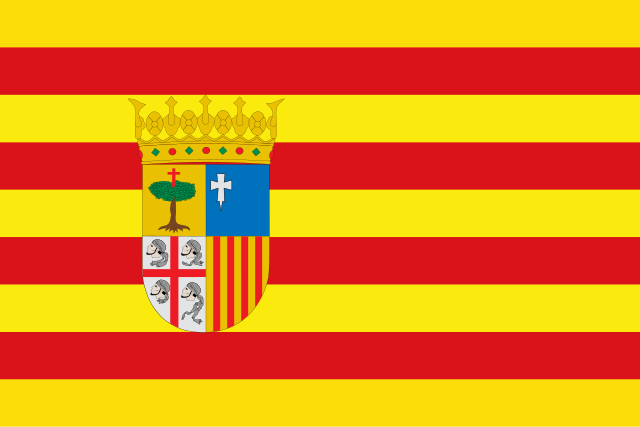
Flag of Aragón (Señera) — Nine yellow and red stripes, officialized in 1982
The flag of Aragón, known as the Señera, displays nine alternating horizontal stripes of equal width — five yellow and four red — with the coat of arms of Aragón placed at the hoist. The pattern directly reproduces the medieval Señal Real of the Crown of Aragón.
The four red bars on gold appear as early as the 12th century on the seal of Ramón Berenguer IV. The combination of five yellow and four red stripes in the flag format is a later heraldic development that became standard for the Kingdom of Aragón. The current flag was officialized with the Statute of Autonomy of Aragón in 1982, directly linking the contemporary autonomous community to its medieval predecessor.
The Señera flies on all official buildings in Aragón alongside the Spanish and European Union flags. The flag without coat of arms is the civil version; the institutional version bears the full coat of arms at the hoist. Aragón's flag is closely related to those of other territories of the former Crown of Aragón, including Cataluña and Valencia, which all share the four red bars on gold as their foundational symbol.
The four red vertical bars (pales) on a gold field are known as the Señal Real, the medieval arms of the Crown of Aragón documented from the 12th century. They are among the oldest continuously used heraldic symbols in Europe.
The third quarter of the coat of arms shows a red cross on silver with four Moors' heads, commemorating the Battle of Alcoraz (1096) in which Pedro I de Aragón captured Huesca. Legend holds that Saint George appeared to aid the Aragonese forces; the Moors' heads represent the defeated commanders.
Íñigo Arista (d. 851) is considered the first king of Pamplona and a founding figure of early Aragón. His cross appears in the second quarter of the coat of arms, linking the autonomous community to the 9th-century origins of the Aragonese kingdom.
Both flags share the same four red bars on gold (the Señal Real of the Crown of Aragón), but Aragón's Señera has nine stripes with the coat of arms at the hoist, while Cataluña's Senyera has four red bars directly on a gold field with no arms. Their shared origin reflects the medieval Crown of Aragón.
The coat of arms of Aragón was officialized by Law 2/1984 of the Cortes de Aragón. The flag was established by the Statute of Autonomy in 1982.
Last reviewed by the Emblema Mundi editorial team on June 29, 2026.