Autonomous Community
Andalucía is the southernmost autonomous community of mainland Spain, stretching from the Atlantic coast to the Mediterranean and the Strait of Gibraltar. One of the largest regions in Europe by area, it has been shaped by Phoenician, Roman, Visigothic, and Islamic civilisations. Under the Umayyad Caliphate and later the Almohad dynasty, the territory flourished as Al-Ándalus, leaving a profound mark on its art, language and heraldry. Reconquered progressively by the Castilian and Aragonese crowns, Andalucía was formally unified under Fernando II de Aragón and Isabel I de Castilla in the late 15th century. Its symbols — the green-white-green flag and the Herculean coat of arms — were formalised during the 20th-century autonomy movement championed by Blas Infante.
Flag
Not available
Coat of Arms
Not available
| Autonomous Community | Andalucía |
|---|---|
| Capital | Sevilla |
| Coat of Arms adopted | 1982 (Law 3/1982) |
| Flag adopted | 1981 (Statute of Autonomy) |
| Colors | Green, white (flag); gold, red, blue (arms) |
| Location | Southern Spain, bordering Portugal, the Atlantic and the Mediterranean |
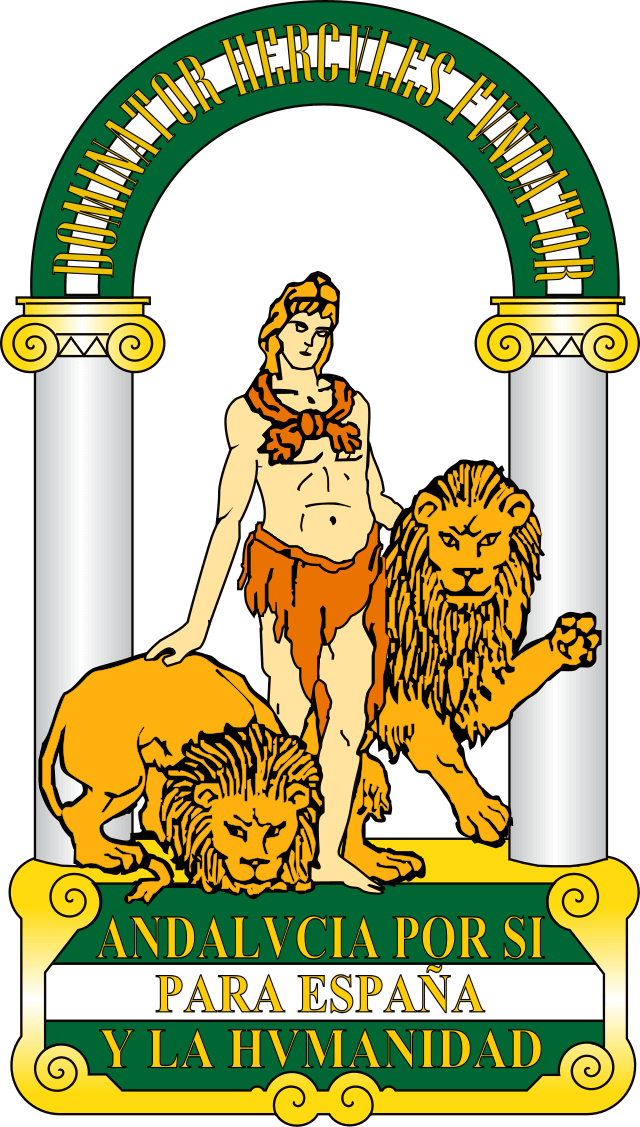
Coat of Arms of Andalucía — Hercules between the Pillars, officialized by Law 3/1982
On a silver field, Hercules standing between two columns (the Pillars of Hercules), each topped with a banner reading Dominator Hercules Fundator; two lions rampant at his feet. Above, a Spanish royal crown.
The figure of Hercules as a founding symbol for southern Iberia dates to antiquity: Strabo and other classical authors identified Cádiz as a Hercules foundation. During the medieval and early modern periods, Seville and Cádiz used Herculean imagery in municipal seals. Blas Infante, the Father of the Andalusian Fatherland, systematised this imagery for the modern Andalucían regionalist movement at the Assembly of Ronda in 1918. The coat of arms was formally adopted for the autonomous community by Law 3/1982 of the Junta de Andalucía.
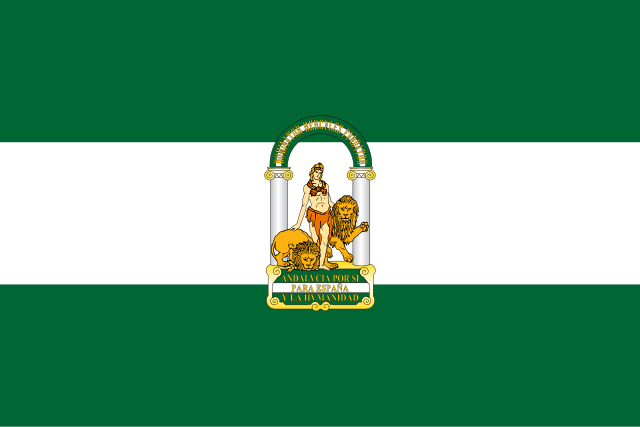
Flag of Andalucía (Arbonaida) — Green-white-green tricolor, officialized in 1981
The flag of Andalucía, popularly called the Arbonaida (from an Arabic word meaning green-white-green), displays three equal horizontal stripes: green at top, white in the middle, and green at the bottom. The coat of arms of Andalucía is centered on the white stripe on the official version used by institutions.
The colors were chosen by Blas Infante at the 1918 Assembly of Ronda, inspired by the banners of the Almohad and Marinid dynasties that had ruled medieval Al-Ándalus. Green and white were the colors most associated with the Islamic rulers of the south, and Infante consciously adopted them to anchor Andalucían identity in its deep pre-Reconquista heritage. The flag was displayed publicly at the 1919 Assembly of Córdoba and again at the 1933 Statute of Benamejí, decades before it received legal status.
The flag was officialized by the Statute of Autonomy of Andalucía in 1981. Today it flies on all public buildings, alongside the Spanish national flag and the European Union flag. The plain tricolor (without coat of arms) is used as the civil flag, while the version with the coat of arms is reserved for official institutional use.
It depicts Hercules between the Pillars of Hercules (symbolising the Strait of Gibraltar), with two lions at his feet and the motto Dominator Hercules Fundator. The arms reference the mythological foundation of Cádiz by Hercules and were adopted by Law 3/1982.
Arbonaida is an Arabic-derived word meaning green-white-green, describing the color sequence of Andalucía's three horizontal flag stripes.
Blas Infante (1885–1936) was the intellectual leader of Andalucían regionalism, named the Father of the Andalusian Fatherland by the Junta de Andalucía in 1983. He designed the flag colors and promoted the coat of arms at the 1918 Assembly of Ronda. He was executed in August 1936 during the Spanish Civil War.
The flag was officially adopted with the Statute of Autonomy of Andalucía, approved by referendum and entering into force in 1981.
The Pillars of Hercules are the two rocky promontories flanking the Strait of Gibraltar — the Rock of Gibraltar to the north and Jebel Musa in Morocco to the south. In antiquity they were considered the edge of the known world, and in Andalucían heraldry they frame Hercules as the mythical founder of the region.
Last reviewed by the Emblema Mundi editorial team on June 29, 2026.