Federal State
Thüringen (Thuringia) is a federal state in central Germany, often called the Grünes Herz Deutschlands (Green Heart of Germany) for its forested highlands. Dissolved under the GDR in 1952, it was reconstituted on 3 October 1990 following German reunification. Its coat of arms bears the striped lion of the medieval Ludowingian Landgraves — a dynasty that ruled Thuringia from the 11th to the 13th century — surrounded by eight silver stars representing the historic Thuringian counties. The white-and-red bicolor flag echoes the same dynastic colors. The state capital is Erfurt.

Flag
Not available
Coat of Arms
Not available
| Federal State | Thüringen (Thuringia) |
|---|---|
| Capital | Erfurt |
| Coat of Arms adopted | 12 November 1990 (readopted) |
| Flag adopted | 25 October 1993 (constitution) |
| Colors | White and red |
| Region | Central Germany |
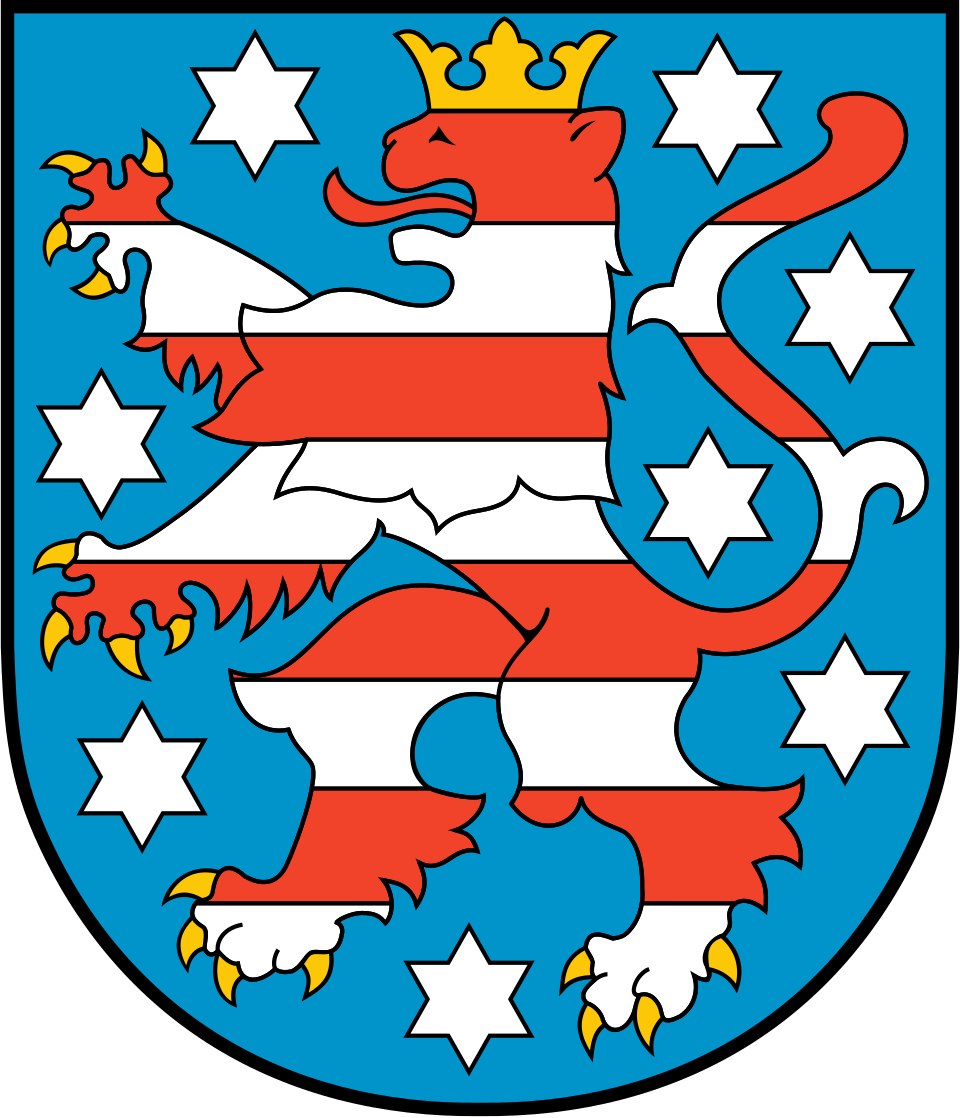
Coat of Arms of Thüringen — readopted 12 November 1990
Azure, a lion rampant barry of eight argent and gules, armed and langued gules, between eight mullets of six points argent arranged in orle. Ensigned with a people's crown (Volkskrone) of gold.
The Ludowingian Landgraves used a striped lion from at least the late 12th century. After the dynasty's extinction in 1247, the Thuringian territories were divided among the Wettin Margraves of Meissen, the Counts of Henneberg, and other lords. The lion arms survived as a collective symbol of the Thuringian region. When the Free State of Thuringia was created on 1 May 1920 under the Weimar Republic by merging seven successor states of the abolished duchies and principalities, the historical lion arms with eight stars were formally adopted. Suppressed under the GDR, they were readopted on 12 November 1990 and confirmed by the state constitution of 25 October 1993.
Flag of Thüringen — white over red bicolor
The flag of Thüringen is a horizontal bicolor of white over red. The state service flag (Dienstflagge) adds the coat of arms centered across both stripes. White (silver) and red are the heraldic colors of the Ludowingian Landgraves, derived from the silver and red of their striped lion. These colors have been associated with Thuringia since the 13th century and are also the inverse of the flag of Hesse — a state that historically separated from the Ludowingian inheritance.
The white-red bicolor was adopted when the Free State of Thuringia was founded in 1920, drawing on the medieval Ludowingian color tradition. Suppressed under the GDR, it was restored when the state was reconstituted in 1990 and confirmed by constitution in 1993. The white-over-red arrangement distinguishes the Thuringian flag from the red-over-white of Poland and from the flags of other German states.
The white-red flag flies on all Thuringian state buildings and the Landtag in Erfurt. It is widely displayed at cultural events celebrating Thuringia's rich heritage — the state is home to Weimar (associated with Goethe, Schiller, and the Bauhaus), the Wartburg (where Martin Luther translated the New Testament), and the Bach birthplace of Eisenach.
The striped lion barry of eight argent and gules on blue derives from the arms of the Ludowingian Landgraves of Thuringia (12th–13th centuries). The eight silver stars represent the eight historic counties and lordships that constituted the Thuringian territory after the Ludowingian dynasty ended in 1247.
The eight silver six-pointed stars represent the historic counties and territories of Thuringia: the former Landgraviate and the counties of Henneberg, Schwarzburg, Beichlingen, Orlamünde, Käfernburg, Gleichen, and Weimar, recalling the fragmentation of Thuringia after the end of the Ludowingian dynasty in 1247.
The coat of arms was readopted by the reconstituted Free State of Thuringia on 12 November 1990, following German reunification on 3 October 1990, and confirmed by the state constitution of 25 October 1993.
White (silver) and red are the heraldic colors of the Ludowingian Landgraves of Thuringia, derived from the silver and red stripes of their lion arms. They have been associated with Thuringia since the 13th century.
Azure, a lion rampant barry of eight argent and gules, armed and langued gules, between eight mullets of six points argent arranged in orle. Ensigned with a people's crown of gold.
Last reviewed by the Emblema Mundi editorial team on June 29, 2026.