Federal State
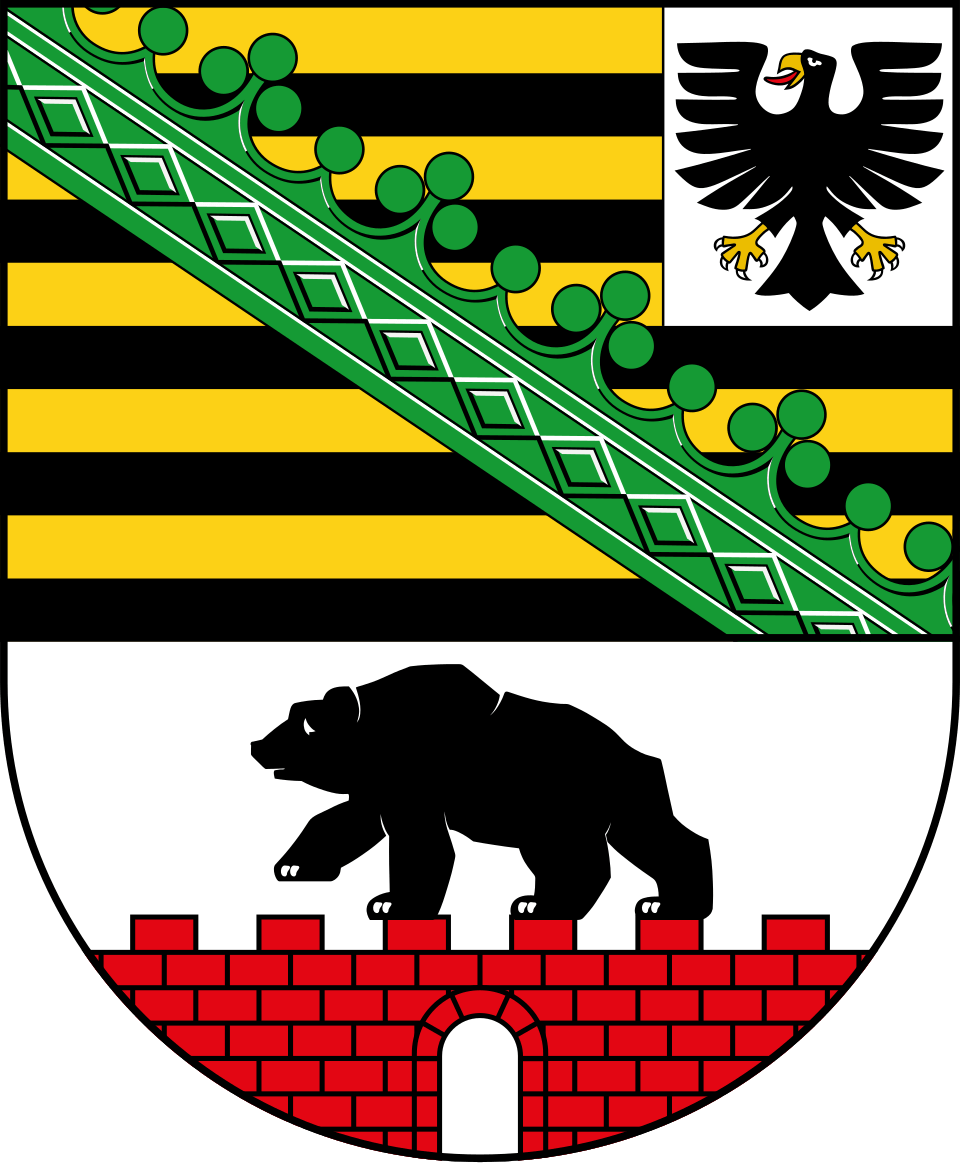
Sachsen-Anhalt (Saxony-Anhalt) is a federal state in central-eastern Germany, created in 1945 from the merger of the former Province of Saxony and the Free State of Anhalt. After dissolution under the GDR in 1952, it was reconstituted on 3 October 1990 following German reunification. Its coat of arms elegantly unites two Ascanian heraldic traditions: the barry of Saxony with its green Rautenkranz on the dexter, and the black bear of Anhalt on a red wall on the sinister — both tracing back to the same medieval dynasty. The state capital is Magdeburg.
Flag
Not available
Coat of Arms
Not available
| Federal State | Sachsen-Anhalt (Saxony-Anhalt) |
|---|---|
| Capital | Magdeburg |
| Coat of Arms adopted | 28 January 1991 (readopted) |
| Flag adopted | 16 July 1992 (constitution) |
| Colors | Gold and black |
| Region | Central-eastern Germany |
Coat of Arms of Sachsen-Anhalt — readopted 28 January 1991
Per pale: dexter, barry of ten sable and or, a bend sinister vert charged with a Rautenkranz or (Saxony); sinister, or, a bear passant sable armed and langued gules on a wall gules (Anhalt). Ensigned with a people's crown (Volkskrone) of gold.
The Ascanians are the heraldic common ancestor of both halves of the shield: the same dynasty produced the Saxon dukes (barry arms) and the Anhalt princes (bear arms) as cadet branches in the 12th century. When Sachsen-Anhalt was first created in 1945 by the Soviet occupation authority, a combined shield was designed to reflect this dual heritage. Suppressed when the GDR dissolved the state in 1952, the coat of arms was formally readopted on 28 January 1991 after the state's reconstitution, and confirmed by the state constitution of 16 July 1992.
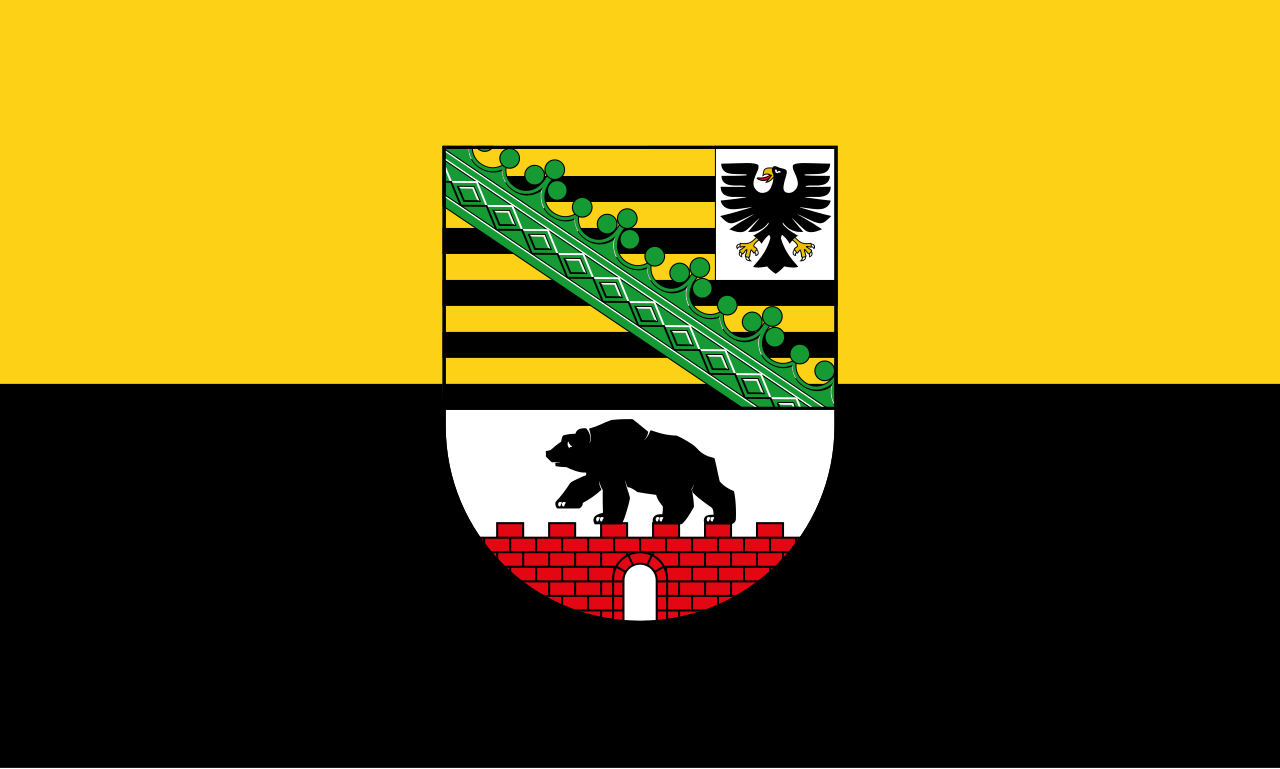
Flag of Sachsen-Anhalt — gold over black bicolor
The flag of Sachsen-Anhalt consists of two equal horizontal stripes: gold (yellow) above black. The state service flag (Dienstflagge) additionally bears the divided coat of arms centered across both stripes. Gold and black are the colors of the Ascanian dynasty, reflecting both the Saxon barry (black and gold stripes) and the Anhalt arms (black bear on gold field).
The gold-and-black bicolor was adopted for Sachsen-Anhalt when the state was established in 1945. It was suppressed under the GDR but restored upon reunification. The flag was confirmed by the state constitution on 16 July 1992. The reversed order — gold above black, rather than the Prussian black above white — distinguishes Sachsen-Anhalt clearly from its neighbors.
The gold-black flag flies on all state buildings and the Landtag in Magdeburg. Sachsen-Anhalt's flag is immediately recognizable at national events due to its distinctive gold-over-black arrangement, unusual among German state flags which predominantly use the national tricolor or white-green bicolors.
The divided shield combines the barry of Saxony with the green Rautenkranz (Ascanian-Wettin arms) and the black bear of Anhalt on a red wall (Ascanian Anhalt line). Both halves trace back to the same medieval Ascanian dynasty, reflecting the 1945 merger of the Province of Saxony and the Free State of Anhalt.
The black bear passant on a gold field is the ancient symbol of the Ascanians in their Anhalt line, borne by the Princes of Anhalt since the 12th century. The red wall beneath the bear distinguishes Anhalt's arms from the plain Ascanian bear used by Berlin and Brandenburg.
The coat of arms was readopted on 28 January 1991, following the reconstitution of the state on 3 October 1990 after German reunification.
Gold and black are the colors of the Ascanian dynasty, which ruled both Saxony and Anhalt in the medieval period. They appear in the barry stripes of the Saxon arms and the field of the Anhalt arms, unifying the two halves of the state under a shared dynastic color scheme.
Per pale: dexter, barry of ten sable and or, a bend sinister vert charged with a Rautenkranz or (Saxony); sinister, or, a bear passant sable armed and langued gules on a wall gules (Anhalt). Ensigned with a people's crown of gold.
Last reviewed by the Emblema Mundi editorial team on June 29, 2026.