Federal State
Saarland is Germany's smallest non-city-state federal state, situated in the southwest on the border with France and Luxembourg. Created as a French protectorate in 1947, it rejoined West Germany on 1 January 1957 following a plebiscite. Its quartered coat of arms assembles the heraldry of four medieval lordships — the County of Saarbrücken, the Electorate of Trier, the Duchy of Lorraine, and the Duchy of Palatinate-Zweibrücken — that competed for control of the Saar valley from the 12th century onward. The state capital is Saarbrücken.
Flag
Not available
Coat of Arms
Not available
| Federal State | Saarland |
|---|---|
| Capital | Saarbrücken |
| Coat of Arms adopted | 9 July 1956 |
| Flag adopted | 1957 |
| Colors | Black, red, gold (flag); or, argent, azure, gules (arms) |
| Region | Southwest Germany |
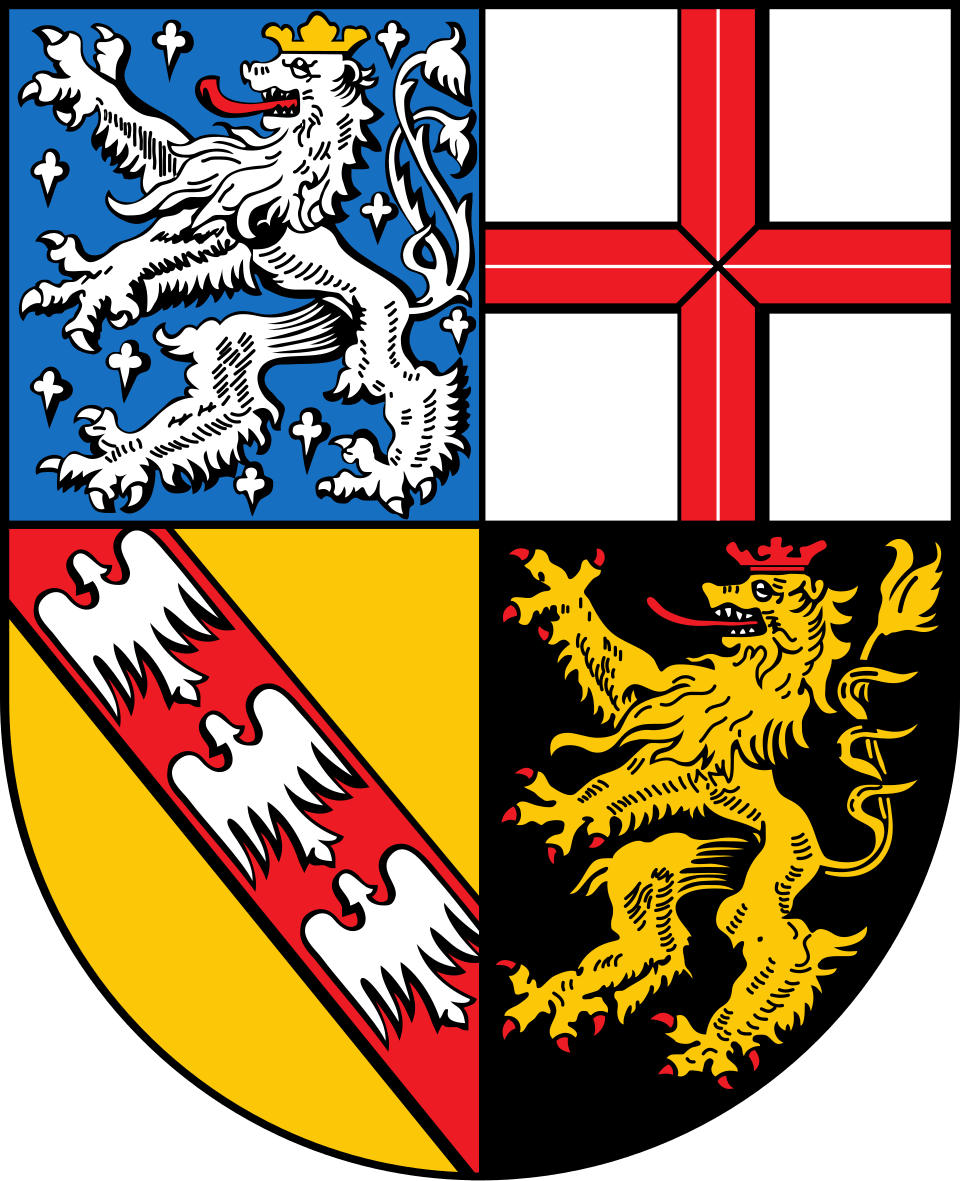
Coat of Arms of Saarland — adopted 9 July 1956
Quarterly: I. Or, a lion rampant gules (Saarbrücken); II. Argent, a cross sable (Trier); III. Argent, three eagles displayed in pall gules (Lorraine); IV. Azure, a lion rampant or crowned or holding a ball gules (Palatinate-Zweibrücken).
During the French protectorate period (1947–1957) the Saarland already had its own coat of arms and symbols separate from those of West Germany. When the Saarland voted in 1955 to reject autonomous status and instead join West Germany, new state symbols were needed. The quartered shield was designed to honor the four principal historical lordships of the Saar basin and was formally adopted on 9 July 1956 — six months before reunification took effect.
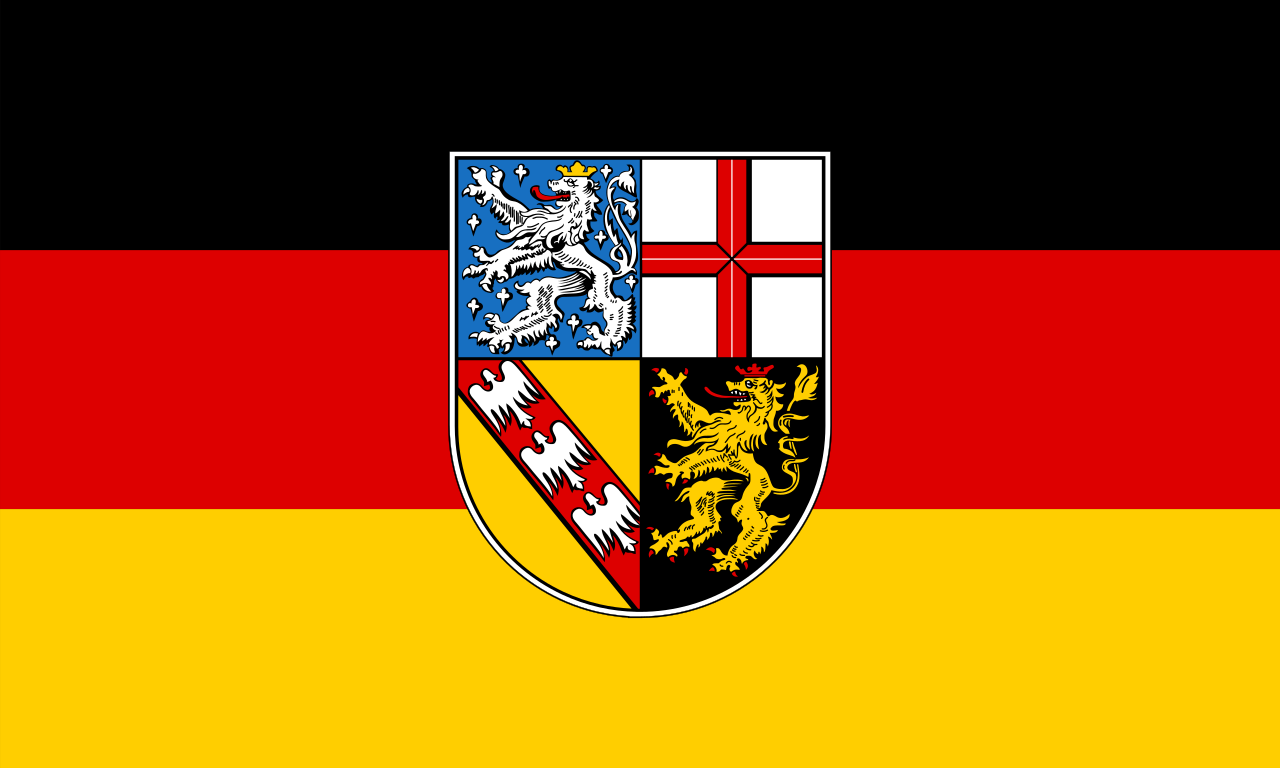
Flag of Saarland — black, red, gold with coat of arms centered
The flag of Saarland displays the German national tricolor — three equal horizontal stripes of black, red, and gold — with the state coat of arms centered across all three stripes. Unlike Rheinland-Pfalz which places the arms in a canton, Saarland places them centrally, in the style of several other German states.
Prior to 1957 the Saarland flew its own distinct flag under the French protectorate. Upon joining West Germany the state adopted the federal tricolor charged with its new quartered coat of arms, symbolizing both national belonging and regional identity. The flag was officialized alongside the coat of arms in 1957.
The flag is flown on all state government buildings and the Landtag in Saarbrücken. A service flag for use on water bears the arms in the same central position. The Saarland also prominently displays its arms on the border crossing signs and motorway gantries entering the state, a tradition maintained since reunification with West Germany.
The quartered shield combines the arms of four historic territories: the red lion of the County of Saarbrücken (Nassau-Saarbrücken), the black cross of Trier, three red eagles of Lorraine, and the crowned lion of Palatinate-Zweibrücken. Together they map the medieval overlordships that shaped the Saar region.
The coat of arms was adopted by state law on 9 July 1956, six months before Saarland's official accession to West Germany on 1 January 1957.
France administered the Saarland as a protectorate from 1947, with its own currency, passport, and Olympic team. A 1955 referendum rejected a proposed statute of autonomy; a subsequent popular vote chose reunification with West Germany, effective 1 January 1957.
The Saarland flag uses the German national tricolor of black, red, and gold, charged in the center with the quartered state coat of arms. The design reflects the state's return to the Federal Republic in 1957.
Quarterly: I. Or, a lion rampant gules (Saarbrücken); II. Argent, a cross sable (Trier); III. Argent, three eagles displayed in pall gules (Lorraine); IV. Azure, a lion rampant or crowned or holding a ball gules (Palatinate-Zweibrücken).
Last reviewed by the Emblema Mundi editorial team on June 29, 2026.