Federal State
Rheinland-Pfalz (Rhineland-Palatinate) is a federal state of southwestern Germany, established on 18 August 1946 under French occupation authority from parts of the former Rhine Province, the Palatinate, and the provinces of Hesse-Nassau and Hesse-Rheinhessen. Its coat of arms and flag draw directly on the heraldry of three great medieval Electoral principalities of the Holy Roman Empire: Trier, Mainz, and the Palatinate. The state capital is Mainz, which lends its iconic wheel — the Mainzer Rad — to the central quarter of the shield.
Flag
Not available
Coat of Arms
Not available
| Federal State | Rheinland-Pfalz (Rhineland-Palatinate) |
|---|---|
| Capital | Mainz |
| Coat of Arms adopted | 10 May 1948 |
| Flag adopted | 1948 |
| Colors | Black, red, gold (flag); argent, sable, or (arms) |
| Region | Southwest Germany |
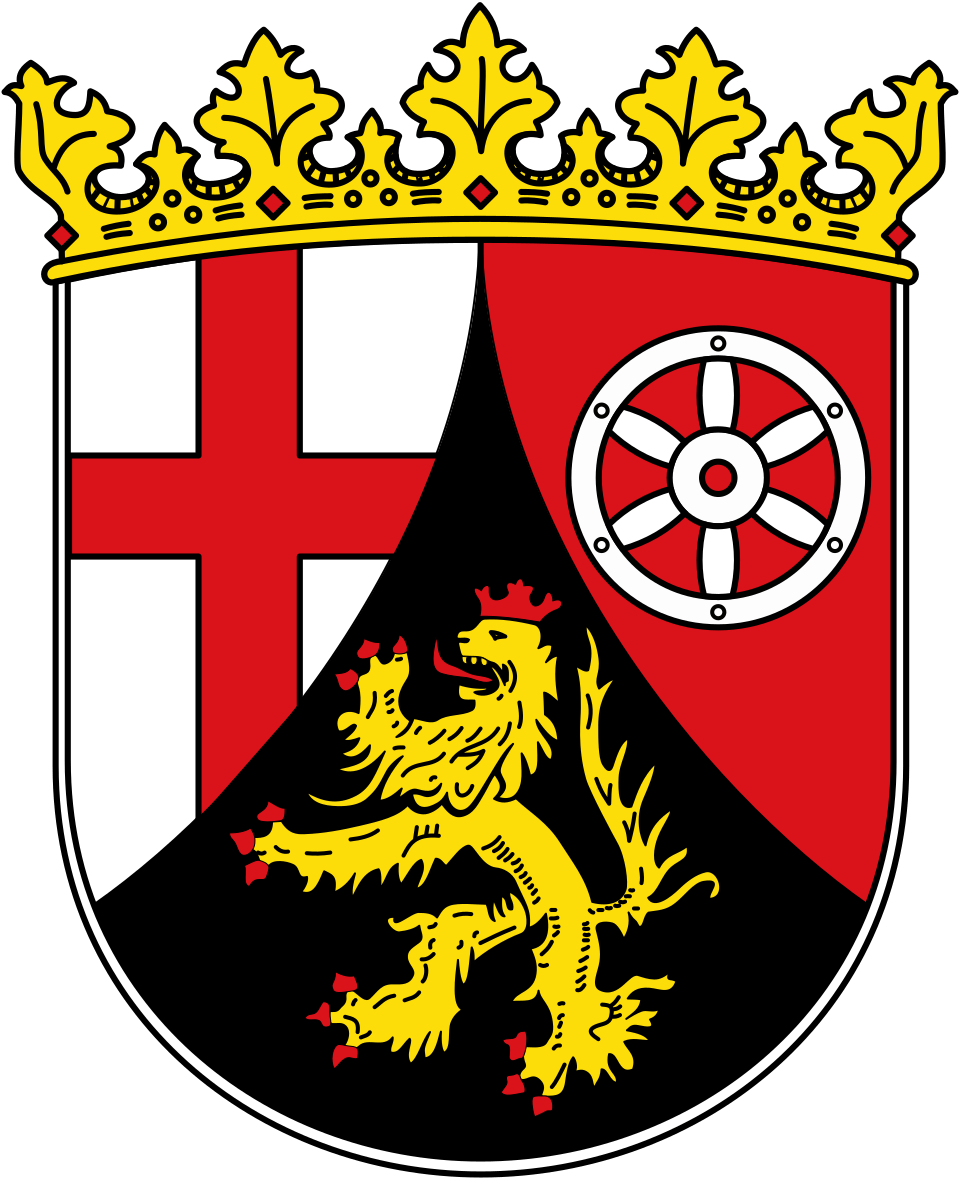
Coat of Arms of Rheinland-Pfalz — officialized 10 May 1948
Per pale and per fess: I. Argent, a cross sable (Trier); II. Argent, a wheel of six spokes sable (Mainz); III. Sable, a lion rampant or (Palatinate). The whole ensigned with a people's crown (Volkskrone) of gold.
None of the three territories depicted had historically formed a single polity. The Electorate of Trier controlled the Moselle valley and western Eifel; the Electorate of Mainz held the Rheingau and Rheinhessen; and the Palatinate ruled the Rhenish lowlands east and west of the Rhine. The French administration that drew the boundaries of Rheinland-Pfalz in 1946 deliberately combined these three ancient Electoral arms to give the new state a heraldic identity rooted in the pre-Napoleonic past of the region, rather than in Prussian or Napoleonic administrative divisions. The coat of arms was formally adopted on 10 May 1948 by state government ordinance.
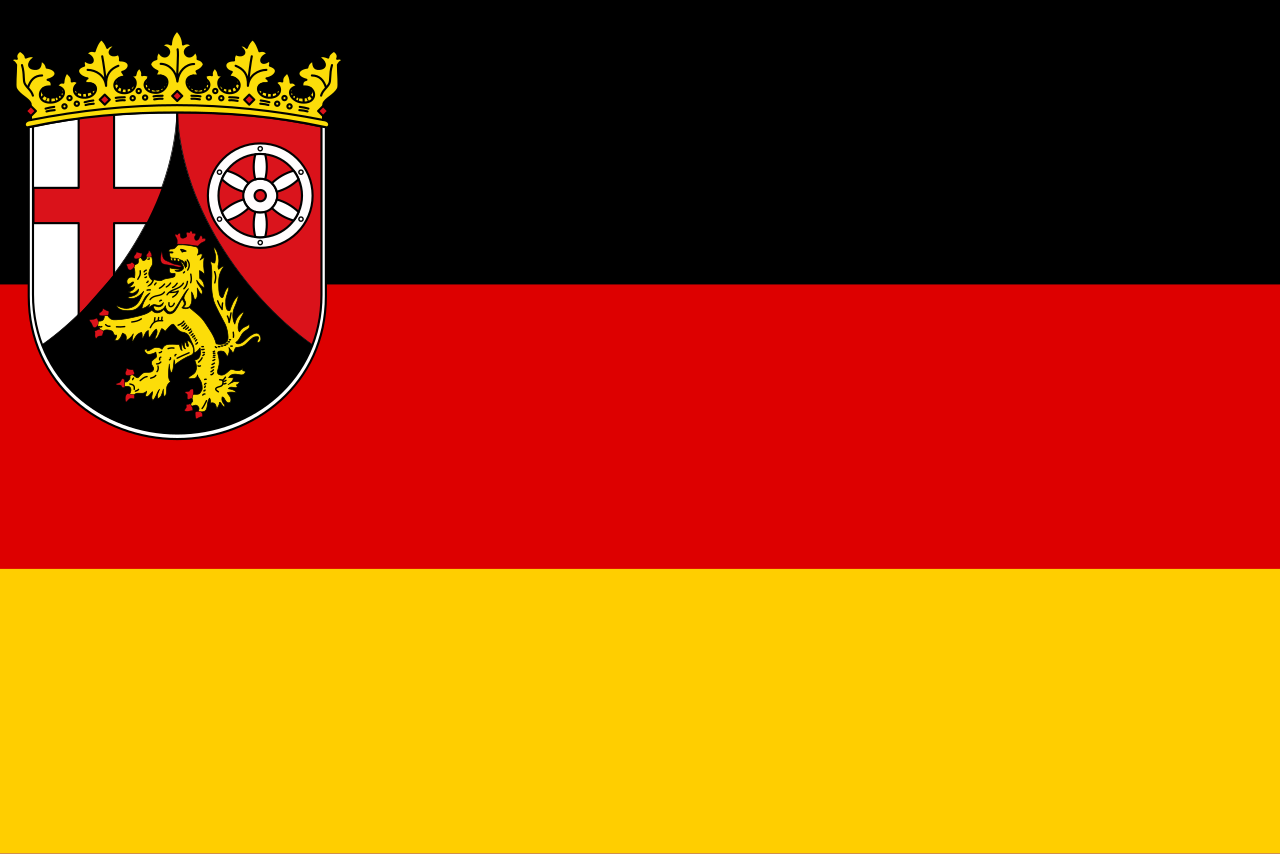
Flag of Rheinland-Pfalz — black, red, gold with coat of arms canton
The flag of Rheinland-Pfalz displays the German national tricolor — three equal horizontal stripes of black, red, and gold — with a canton in the upper hoist side bearing the state coat of arms. The tricolor occupies the full fly, while the canton shows the tripartite shield on a reduced scale, clearly distinguishing the state flag from the plain federal tricolor.
The design follows the model established for several West German states after 1945: the federal colors provide continuity with the democratic tradition of 1848 and the Weimar Republic, while the state arms in the canton give individual identity. The flag was officialized by state ordinance in 1948, the same year as the coat of arms.
The flag is flown on all state government buildings, the Landtag (state parliament), and official delegations. A service flag (Dienstflagge) bearing the arms centered on the tricolor is used by state authorities on water. Citizens may fly the plain black-red-gold tricolor; the flag with the canton is the official state flag.
The tripartite shield combines three historic Electoral territories along the Rhine: the black cross of Trier, the Mainzer Rad of Mainz, and the golden lion of the Electoral Palatinate (Kurpfalz). Together they reflect the state's 1946 merger of former ecclesiastical and secular principalities of the Holy Roman Empire.
The coat of arms was officialized by state ordinance on 10 May 1948, shortly after the state's establishment on 18 August 1946 under French occupation authority.
Per pale and per fess: I. Argent, a cross sable (Trier); II. Argent, a wheel of six spokes sable (Mainz); III. Sable, a lion rampant or (Palatinate). Ensigned with a people's crown of gold.
The black, red, and gold stripes are the colors of the German national flag, expressing solidarity with the Federal Republic and the democratic tradition of 1848. The coat of arms in the canton identifies the specific state and its three historical territories.
The Mainzer Rad (Wheel of Mainz) is a black six-spoked cartwheel on a silver field, the heraldic symbol of the Archbishopric and Electorate of Mainz since the 13th century. It appears as the second quarter of the Rheinland-Pfalz coat of arms and is also the coat of arms of the city of Mainz.
Last reviewed by the Emblema Mundi editorial team on June 29, 2026.