Federal State
Niedersachsen (Lower Saxony) is the second-largest federal state of Germany by area, stretching from the North Sea coast to the Harz mountains. Its coat of arms carries the Sachsenross — a galloping white horse on red — an emblem of ancient Saxon identity. Its flag is the German federal tricolor (black-red-gold) defaced with the state arms, making Niedersachsen one of the only German states to use the national colors rather than distinct regional ones, a deliberate expression of its post-war democratic identity.
Flag
Not available
Coat of Arms
Not available
| Federal State | Niedersachsen (Lower Saxony) |
|---|---|
| Capital | Hannover (Hanover) |
| Coat of Arms adopted | 13 October 1952 |
| Flag adopted | 13 October 1952 |
| Colors | White (argent) on red (gules); flag in black, red, gold |
| Region | Northwestern Germany |
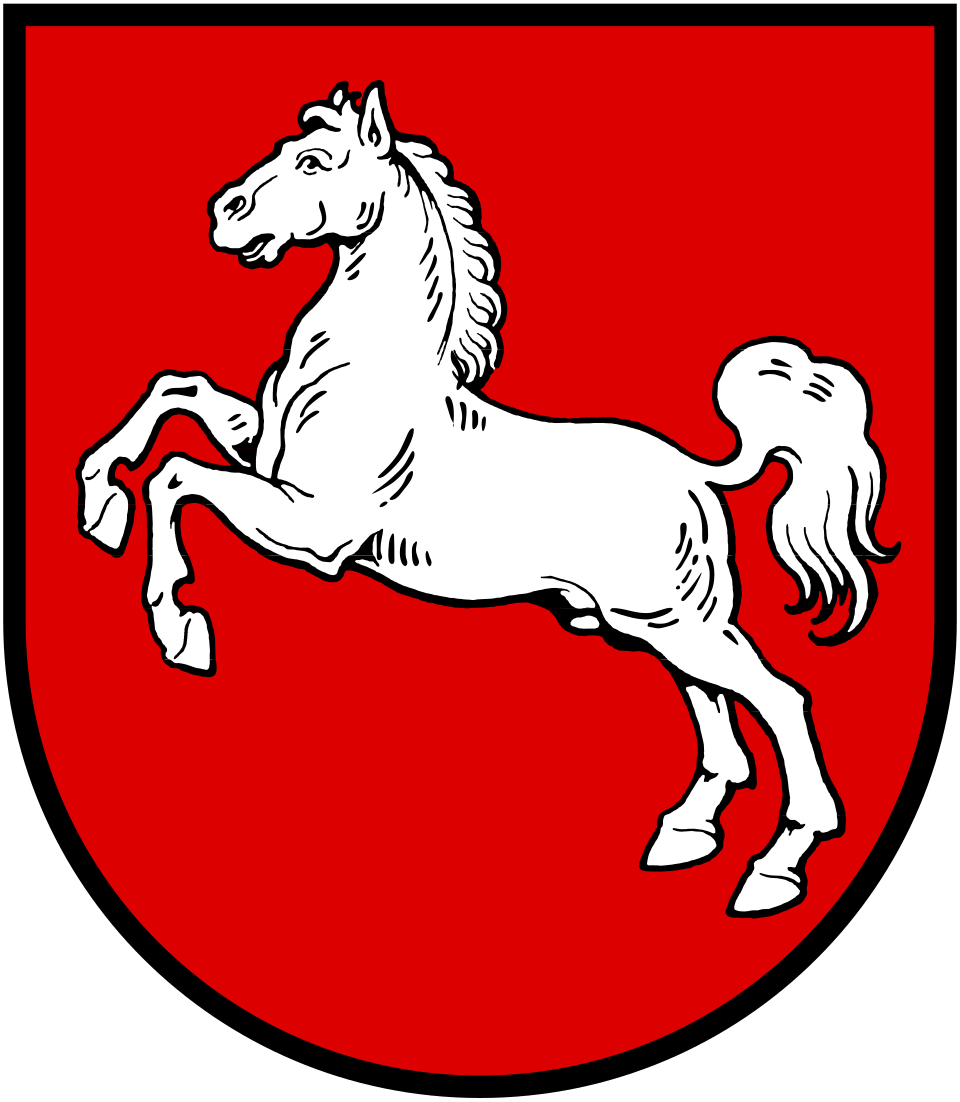
Coat of Arms of Niedersachsen — the Sachsenross (Saxon Steed) on red
Gules, a horse courant Argent. Ensigned with a mural crown of the people.
The white horse on red has been associated with the Saxon people since at least the early medieval period. According to a persistent legend, the symbol was carried by Widukind, the Saxon chieftain who led resistance against Charlemagne in the late 8th century. Historically, its first documented heraldic use is attributed to the Welf dynasty of the Duchy of Brunswick-Lüneburg in the 14th century, from where it spread to virtually all the successor states of the Saxon lands. When the British occupation authorities created Niedersachsen on 1 November 1946 by merging the Province of Hanover, the Free State of Brunswick, the Free State of Oldenburg, and the Free State of Schaumburg-Lippe, the Sachsenross was the only credible unifying symbol for all four territories. The current arms were officialized by state law on 13 October 1952.
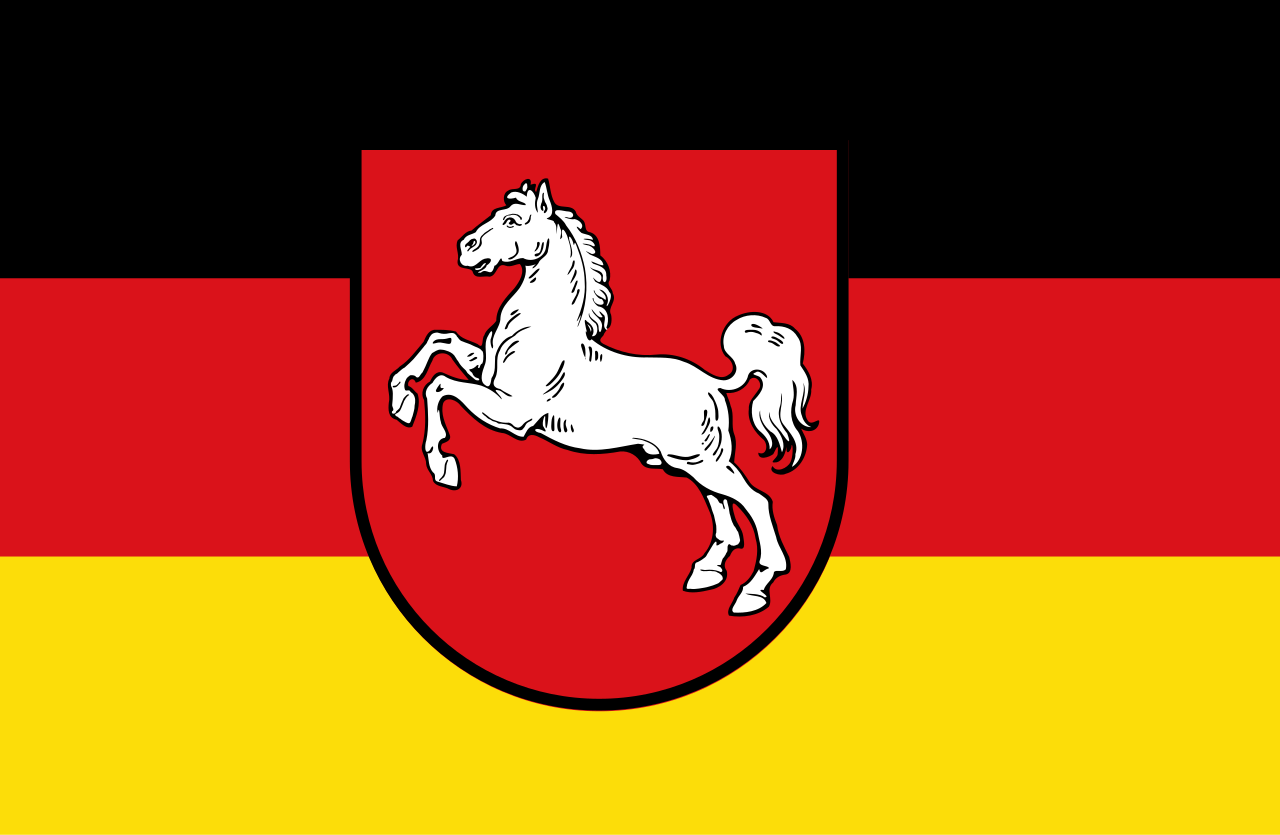
Flag of Niedersachsen — German tricolor defaced with the Sachsenross arms
The flag of Niedersachsen uses the German national tricolor — three equal horizontal stripes of black, red, and gold — with the state coat of arms (the Sachsenross on red, ensigned with the people's crown) centered on the red stripe. It is one of the very few German state flags to use the federal colors rather than regional heraldic colors.
The choice of the German tricolor for Niedersachsen's flag was a deliberate political statement made in the early Federal Republic: the new state identified itself primarily as a component of the democratic German nation rather than promoting a distinct regional tradition. The state law of 13 October 1952 formalized both the flag and the coat of arms simultaneously.
The flag flies on all state buildings and is used at official state functions. The defaced version with the Sachsenross is the standard state flag; a plain black-red-gold tricolor without arms is also permissible for civil use. The Sachsenross itself has broader cultural resonance: it appears in the emblems of numerous Lower Saxon municipalities and institutions, and is widely used in regional branding.
The coat of arms features the Sachsenross — a galloping white horse on red — the ancient symbol of the Saxon people. It unifies the four historical territories merged into Niedersachsen in 1946: the Province of Hanover, the Free State of Brunswick, the Free State of Oldenburg, and the Free State of Schaumburg-Lippe, all of which had used the Saxon horse in their own arms.
The Sachsenross (Saxon Steed) is a galloping white horse on a red field. By tradition it is linked to Widukind, the 8th-century Saxon chieftain who resisted Charlemagne. Historians trace its first documented heraldic use to the Welf dynasty of the Duchy of Brunswick-Lüneburg in the 14th century. It remains one of the most widely used regional symbols in Germany.
Niedersachsen deliberately chose the federal black-red-gold tricolor for its flag to express strong identification with the post-war Federal Republic of Germany. It is one of only a few German states to adopt the national colors rather than distinct regional heraldic colors. The defaced version with the state coat of arms was formalized by state law on 13 October 1952.
Niedersachsen was created on 1 November 1946 through the merger of the Province of Hanover, the Free State of Brunswick, the Free State of Oldenburg, and the Free State of Schaumburg-Lippe. Its capital is Hannover.
The coat of arms of Niedersachsen was officially adopted by state law on 13 October 1952, at the same time as the state flag. The design — Sachsenross on red, ensigned with the people's crown — has remained unchanged since.
Last reviewed by the Emblema Mundi editorial team on June 29, 2026.