Federal State
Mecklenburg-Vorpommern is a federal state in northeastern Germany, bordering the Baltic Sea and sharing frontiers with Poland. Its coat of arms is a heraldic panorama of the region's medieval past: the Stierkopf (bull's head) of Mecklenburg, the red griffin of Pomerania, and the eagle of Brandenburg — three symbols representing three distinct historical territories now united in one state. Its flag, with five stripes in blue, white, yellow, white, and red, was designed to weave together those same territorial color traditions after reunification in 1990.
Flag
Not available
Coat of Arms
Not available
| Federal State | Mecklenburg-Vorpommern |
|---|---|
| Capital | Schwerin |
| Coat of Arms adopted | 23 May 1993 (state constitution) |
| Flag adopted | 29 January 1991 |
| Colors | Blue, white, yellow, red (flag); or, argent, gules (arms) |
| Region | Northeastern Germany |
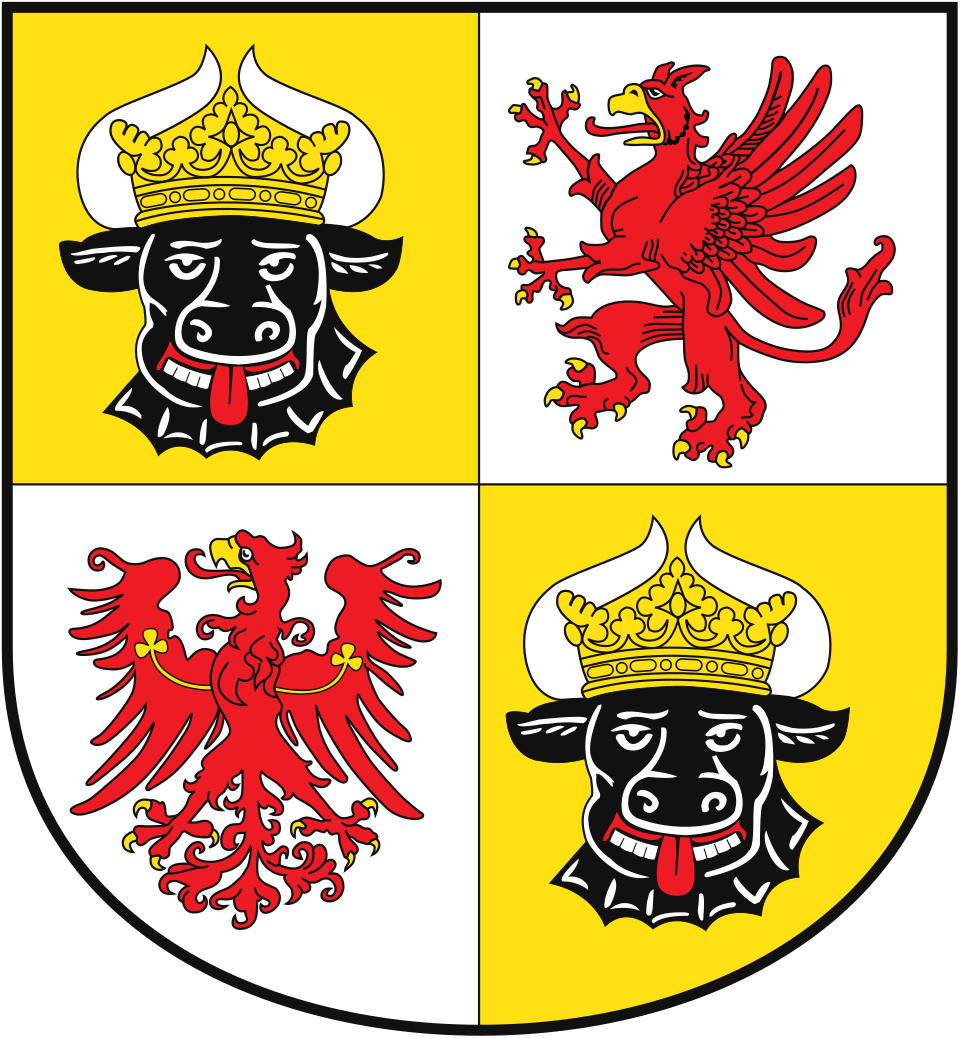
Coat of Arms of Mecklenburg-Vorpommern — quartered: bull's head, griffin, eagle
Quarterly: I & IV. Or, a bull's head (Stierkopf) Sable, crowned Or, horned Argent, langued Gules (Mecklenburg); II. Argent, a griffin displayed Gules (Pomerania); III. Argent, an eagle displayed Gules (Brandenburg). Ensigned with a mural crown of the people.
The medieval House of Mecklenburg, of Slavic Obotrite descent, adopted the bull's head as their dynastic emblem by the 12th century — one of the oldest continuously used heraldic charges in the German lands. The Pomeranian griffin was the symbol of the Duchy of Pomerania, which ended with the extinction of the Griffins dynasty (Greifenhaus) in 1637 and was partitioned between Sweden and Brandenburg-Prussia. After German reunification, the new federal state created in 1990 needed arms that could represent both halves of its name. The quartered shield adopted by the state constitution of 23 May 1993 achieved this by combining the bull's head (Mecklenburg), griffin (Vorpommern/Pomerania), and Brandenburg eagle.
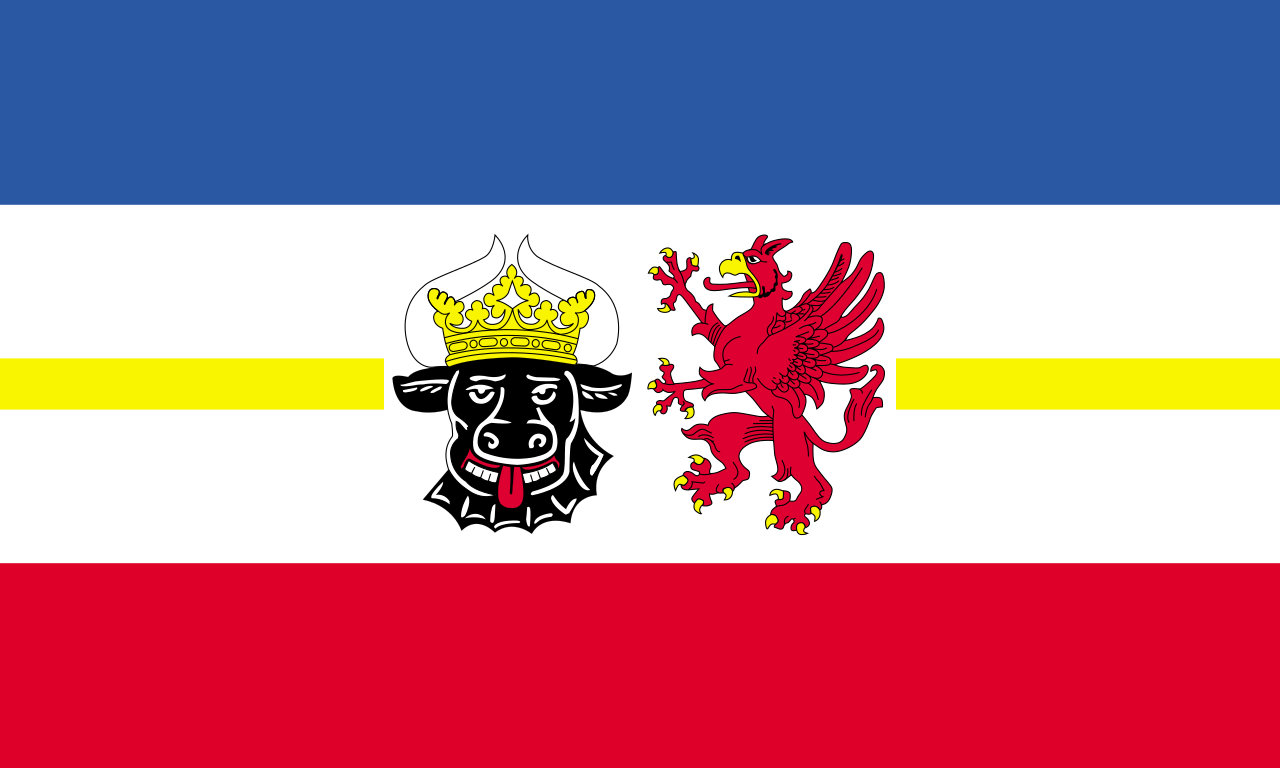
Flag of Mecklenburg-Vorpommern — five stripes: blue, white, yellow, white, red
The flag consists of five horizontal stripes from top to bottom: ultramarine blue, narrow white, broad yellow, narrow white, and red. The yellow central stripe is twice the width of each of the two white separating stripes. The state service flag (Landesdienstflagge) additionally centers the state coat of arms on the yellow stripe.
The flag was designed by historian Norbert Buske and adopted by the state parliament on 29 January 1991. The five-stripe design deliberately combines the heraldic color traditions of the two constituent territories: blue, yellow, and red for Mecklenburg; blue and white for Pomerania. The blending of both palettes into a single flag was a conscious act of regional identity-building after reunification.
The flag of Mecklenburg-Vorpommern flies on all state buildings and is a standard fixture of the Baltic coast tourism landscape. Its five-stripe design is distinctive among German state flags, which more commonly use two or three stripes. The Landesdienstflagge with the quartered arms is used by state ministries, police, and official delegations.
The quartered coat of arms combines the symbols of three historical territories: the black bull's head (Stierkopf) of Mecklenburg in quarters I and IV, the red griffin of Pomerania in quarter II, and the red eagle of Brandenburg in quarter III. Together they map the medieval geography of northeastern Germany onto a single heraldic shield.
The black bull's head (Stierkopf) with a golden crown, silver horns, and red tongue on a gold field is the ancient symbol of the House of Mecklenburg, a dynasty of Slavic Obotrite origin that ruled the region from the 12th century. It is one of the oldest continuously used heraldic charges in Germany.
The five stripes — blue, white, yellow, white, red — blend the heraldic colors of Mecklenburg (blue, yellow, red) and Pomerania (blue, white). Designed by Norbert Buske and adopted on 29 January 1991, the flag was a deliberate act of post-reunification identity-building for the newly re-established state.
The red griffin displayed on a silver field is the principal symbol of Pomerania (Pommern), used by the ruling Greifenhaus (Griffin dynasty) from at least the 13th century. The dynasty died out in 1637, but the griffin remained the emblem of the region and was incorporated into the coat of arms of Mecklenburg-Vorpommern in 1993.
Mecklenburg-Vorpommern was re-established as a federal state on 3 October 1990, the day of German reunification, from the former GDR districts of Rostock, Schwerin, Neubrandenburg, Stralsund, and Greifswald. Its capital is Schwerin.
Last reviewed by the Emblema Mundi editorial team on June 29, 2026.