Country
The Portuguese coat of arms — five blue quinas within a red bordure of seven castles — is among the oldest continuously used national arms in Europe, with roots going back to the twelfth century. Paired with the green-red flag of 1911 and its esfera armilar, it links medieval Christian Iberia to the maritime empire of the Age of Discoveries and to the Republican break with monarchy.
Flag
Not available
Coat of Arms
Not available
| Country | Portugal (República Portuguesa) |
|---|---|
| Coat of arms — current form | 30 June 1911 |
| Origins | 12th century, under King Afonso I |
| Flag adopted | 30 June 1911, after the Republican Revolution of 5 October 1910 |
| Tinctures (arms) | Argent, Azure, Gules, Or |
| Blazon | Argent, five escutcheons Azure each charged with five plates Argent in saltire, within a bordure Gules charged with seven castles Or |
| Flag colours | Green (hoist, 2/5), red (fly, 3/5) |
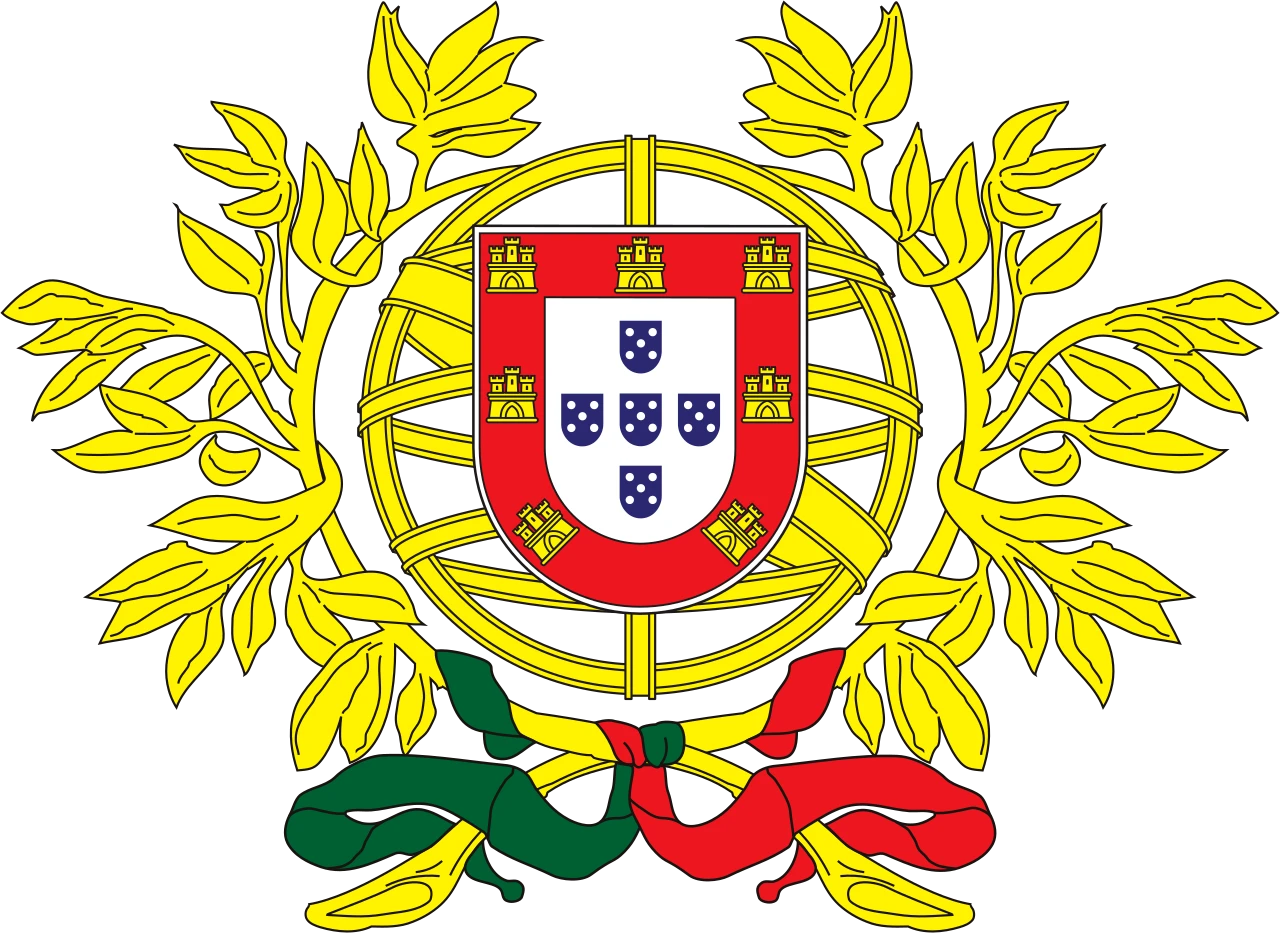
Coat of Arms — Argent, five escutcheons Azure within a bordure Gules charged with seven castles Or.
Argent, five escutcheons Azure each charged with five plates Argent in saltire, within a bordure Gules charged with seven castles Or.
The shield is divided into two heraldic ideas that have evolved independently over eight centuries: the inner five quinas, dating from the very foundation of the Portuguese kingdom, and the outer bordure of seven castles, added in the thirteenth century to mark a dynastic alliance with Castile.
The quinas are the five small blue shields arranged in a cross pattern, each charged with five silver bezants (besantes or plates) in saltire. They are the oldest element of Portuguese heraldry and the very symbol from which the country takes its medieval name.
Tradition attributes the design to King Afonso I (Afonso Henriques), founder of the kingdom, after the Battle of Ourique (1139). According to the legend, on the eve of the battle Afonso received a vision of Christ on the cross promising victory; the five quinas represent the Five Wounds of Christ, and the silver bezants the thirty pieces of silver (later stylised as five per shield, totalling twenty-five visible).
The historical reality is more prosaic: simple silver shields with blue charges appear on Afonso I's seals from the 1140s; the cross arrangement of five quinas was stabilised under King Sancho I (1185–1211), and the precise number of bezants per quina varied for centuries before being fixed at five during the late Middle Ages.
The red bordure with golden castles was added by King Afonso III after his marriage to Beatriz de Castela (Beatrice of Castile) in 1253. The castles directly reference the Castilian royal arms (Castilla = "land of castles") and signalled the new dynastic ties between the two Iberian kingdoms.
The number was not fixed at the start. Medieval seals and manuscripts show variations from eight to sixteen castles on the bordure. The seven-castle convention emerged during the reign of King João I (1385–1433), founder of the House of Aviz, and became universal in the fifteenth century.
c. 1140 — Afonso I. Earliest blue charges on a silver shield appear on the royal seals.
c. 1200 — Sancho I. Five quinas arranged in cross — the canonical layout — appears.
1253 — Afonso III. Red bordure with castles introduced after marriage to Beatriz de Castela.
15th c. — João I. Number of castles fixed at seven, number of bezants per quina fixed at five.
1495–1521 — Manuel I. The armillary sphere becomes the king's personal device, associated with Portuguese maritime expansion.
1816–1822 — United Kingdom of Portugal, Brazil and the Algarves. The arms are quartered with a Brazilian armillary sphere, the only major modification before the Republic.
30 June 1911 — Republican simplification. The current form, retaining only the historic shield without crown or ornaments, is adopted by the First Republic.
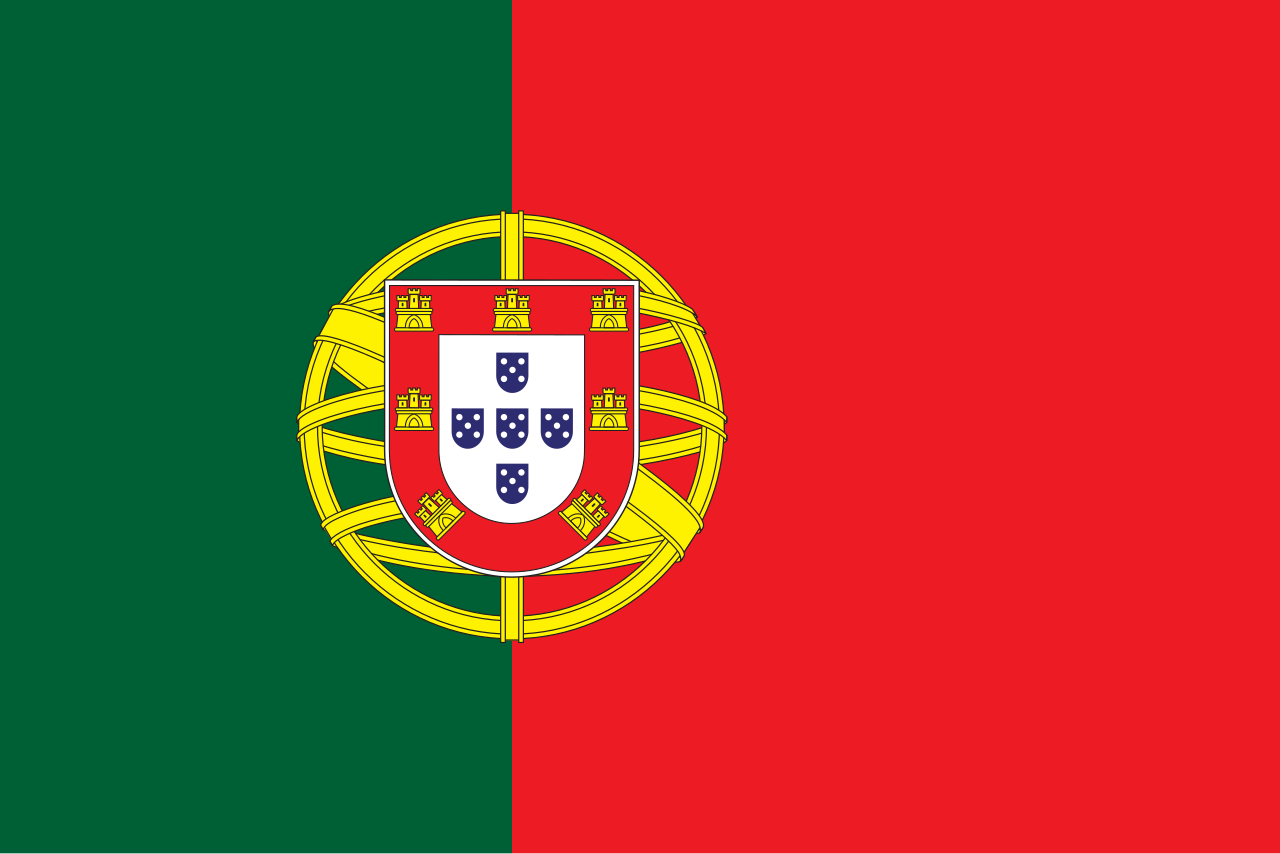
Flag — Vertically divided green (hoist) and red (fly), with the coat of arms over an armillary sphere on the boundary.
The current flag was adopted on 30 June 1911, eight months after the Republican Revolution of 5 October 1910 overthrew King Manuel II and ended seven centuries of monarchy. The design was the work of a committee that included the painter Columbano Bordalo Pinheiro, the writer Abel Botelho, the journalist João Chagas, and the army officer Ladislau Piçarra.
The committee deliberately broke with the blue and white of the monarchic flag, choosing instead the green and red of the Republican Party and of the Carbonária — the secret society that had organised the 1908 regicide of King Carlos I.
| Band | Tradition | Meaning |
|---|---|---|
| Green (hoist, 2/5) | Republican | Hope, the future, the renewal promised by the new Republic. |
| Red (fly, 3/5) | Revolutionary | The blood of those who died for Portugal — explicitly that of the revolutionaries of 1910 and, by extension, all Portuguese who fell for the nation. |
The esfera armilar on the colour boundary is the most distinctive element of the flag — and the only national flag in the world to bear this device. The armillary sphere is a medieval astronomical instrument used to model the celestial sphere and the paths of the stars, indispensable to ocean navigation before the development of accurate marine chronometers.
It became the personal emblem of King Manuel I "the Fortunate" (1495–1521), under whose reign Portuguese navigators reached India (Vasco da Gama, 1498), Brazil (Pedro Álvares Cabral, 1500) and circumnavigated the globe (Magellan's expedition, 1519–1522). The sphere subsequently appeared on royal flags, then on the flag of the Kingdom of Brazil within the Lusitanian crown (1815–1822), and was retained by the Republic of 1911 as a symbol of Portugal's global maritime heritage.
Portugal includes two autonomous regions (regiões autónomas), each with its own coat of arms and flag:
Continental Portugal is divided into eighteen distritos (districts), inheritors of the historic provinces (províncias históricas): Minho, Trás-os-Montes, Beira Alta, Beira Baixa, Beira Litoral, Estremadura, Ribatejo, Alto Alentejo, Baixo Alentejo, and Algarve. Notable district arms include:
The quinas are the five small blue escutcheons charged with five silver bezants (plates) each, arranged in a cross pattern on the silver shield. They are the oldest element of the Portuguese arms, traditionally attributed to King Afonso I after the legendary Battle of Ourique in 1139, and symbolise the Five Wounds of Christ in religious tradition.
The red bordure with golden castles was added by King Afonso III after his marriage to Beatriz de Castela in 1253, referencing his Castilian connections. The number varied historically — sometimes up to sixteen — before being fixed at seven during the reign of King João I in the late fourteenth century.
The esfera armilar is a medieval astronomical instrument used by navigators to model the celestial sphere. It became the personal emblem of King Manuel I (1495–1521) during the Age of Discoveries and was incorporated into the Republican flag of 1911 to honour Portugal's maritime heritage. Portugal is the only country in the world to feature this device on its national flag.
Green represents hope and was associated with the Republican movement that overthrew the monarchy on 5 October 1910. Red represents the blood of those who died for the nation. The colours deliberately broke with the blue and white of the previous monarchic flag and echoed the symbols of the Republican Party and the Carbonária secret society.
On 30 June 1911, by decree of the Constituent Assembly of the First Portuguese Republic. The design was the work of a committee including the painter Columbano Bordalo Pinheiro and the writer Abel Botelho.
Last reviewed by the Emblema Mundi editorial team on 14 June 2026.