Historical State
Rhodesia — Coat of Arms and Flag
The emblems of Rhodesia belong to a state that no country ever recognised. The coat of arms — a golden miner’s pick on a green field, beneath the red lion and thistles of Cecil John Rhodes and crested by the Great Zimbabwe Bird — was granted by Royal Warrant in 1924, when Southern Rhodesia was a self-governing British colony. The green-white-green flag, by contrast, is a product of the breakaway years: adopted on 11 November 1968, the third anniversary of the Unilateral Declaration of Independence, it flew over an unrecognised republic until the country became Zimbabwe in 1980.
Quick Facts
| State | Southern Rhodesia (colony, 1923) → Rhodesia (after UDI, 1965) → Republic of Rhodesia (1970) |
|---|---|
| Coat of arms granted | Royal Warrant, 11 August 1924 |
| Flag (green-white-green) adopted | 11 November 1968 — Flag of Rhodesia Act, 1968 |
| Flag designer | Geoffrey Turner-Dauncey |
| Flag ratio | 1:2 |
| Tinctures (arms) | Vert, Or, Argent, Gules |
| Motto | Sit Nomine Digna — “May she be worthy of the name” |
| Emblems superseded | Flag, 2 September 1979 (Zimbabwe Rhodesia); state, 18 April 1980 (Zimbabwe) |
| Successor state | Republic of Zimbabwe |
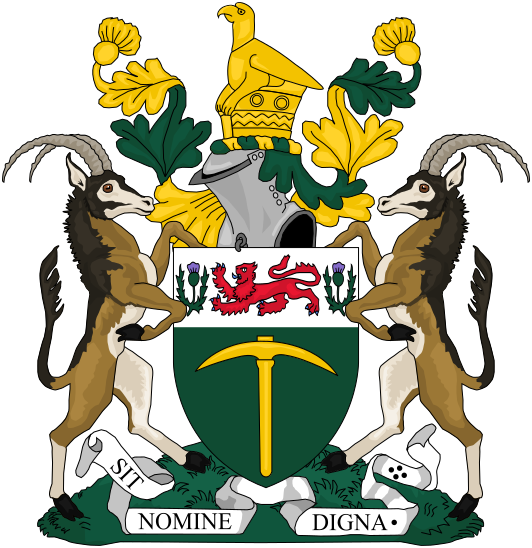
Coat of Arms of Rhodesia — Vert, a pick Or; on a chief Argent a lion passant Gules between two thistles proper. Crest: the Great Zimbabwe Bird Or. Granted by Royal Warrant, 11 August 1924.
Coat of Arms of Rhodesia
Blazon
Vert, a pick paleways Or; on a chief Argent a lion passant Gules, armed and langued Azure, between two thistles slipped and leaved proper. Crest: upon a wreath Or and Vert, a representation of the Great Zimbabwe Bird Or. Supporters: on either side a sable antelope proper. Motto: Sit Nomine Digna.
The arms were drawn up in London and granted by Royal Warrant on 11 August 1924, a year after Southern Rhodesia had left the administration of the British South Africa Company to become a self-governing colony. They are a compact statement of the colony’s self-image: a mineral economy (the pick), an agrarian land (the green field), a founder-hero (the Rhodes charges), and an appropriated antiquity (the bird).
Tincture Table & Symbolism
| Colour | Heraldic name | Element | Traditional symbolism |
|---|---|---|---|
| Green | Vert | Field of the shield | The land and its agriculture |
| Gold | Or | Pick; the crest bird | Mining, and specifically gold; mineral wealth |
| Silver | Argent | Chief | The band carrying the founder’s charges |
| Red | Gules | Lion passant | Taken from the personal arms of Cecil John Rhodes |
| Blue | Azure | Lion’s claws and tongue (armed and langued) | Heraldic detailing of the lion |
The Golden Pick and the Rhodes Lion
The gold pick, standing upright on the green field, is the heart of the shield: it marks mining — and above all the gold whose promise had drawn the British South Africa Company north of the Limpopo in the 1890s — as the engine of the colony’s economy, while the green ground beneath it stands for farming.
The silver chief across the top carries a red lion between two thistles. These are not generic charges: they are lifted directly from the personal coat of arms of Cecil John Rhodes, the mining magnate, Cape premier and imperialist for whom the country was named. Fixing his device at the head of the shield turned the colony’s arms into a heraldic monument to its founder.
The Great Zimbabwe Bird
The crest is a golden representation of the Great Zimbabwe Bird — the carved soapstone raptor recovered from the medieval dry-stone city of Great Zimbabwe, built by ancestors of the Shona between roughly the 11th and 15th centuries. Colonial heraldry placed the bird atop the arms as a token of the country’s deep past. The image outlived the state that borrowed it: independent Zimbabwe took both its name and its central national emblem from those same ruins and their bird.
Historical Evolution
1890s — The territory is administered by Cecil Rhodes’s British South Africa Company, which uses its own corporate arms.
1 October 1923 — Southern Rhodesia is annexed to the Crown and becomes a self-governing colony.
11 August 1924 — grant of arms. The Royal Warrant fixes the pick, chief, lion, thistles, Zimbabwe Bird, sable antelopes and the motto Sit Nomine Digna.
1953–1963 — The colony belongs to the short-lived Federation of Rhodesia and Nyasaland, which has arms of its own; Southern Rhodesia keeps its 1924 shield throughout.
1965–1979 — The arms are retained without change through the Unilateral Declaration of Independence and the Republic of 1970.
21 September 1981 — Independent Zimbabwe adopts an entirely new coat of arms, retaining only the Zimbabwe Bird; the 1924 achievement is retired.
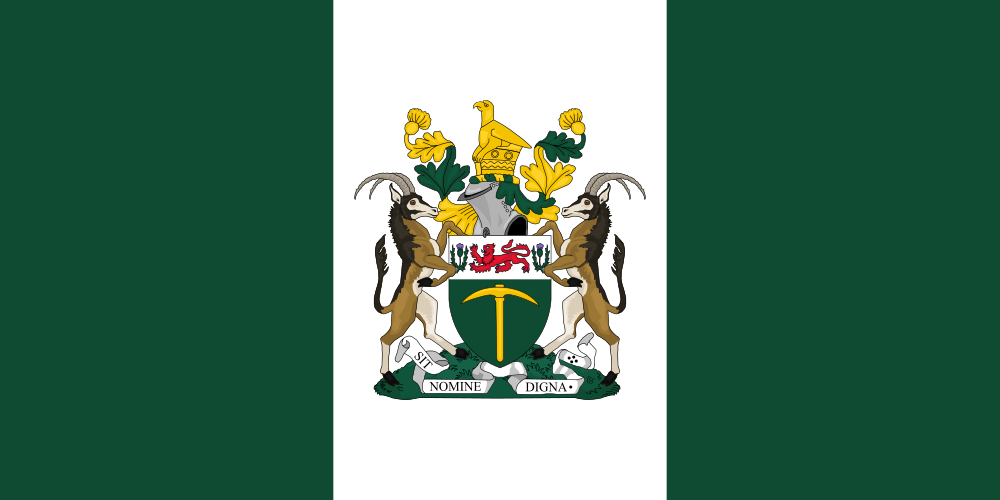
Flag of Rhodesia (1968–1979) — Three equal vertical stripes, green-white-green, the coat of arms centred on the white. Ratio 1:2. Adopted 11 November 1968.
Flag of Rhodesia
From the British Ensign to a Light-Blue Field
For most of its colonial life Rhodesia flew British ensigns defaced with its arms. From the late 1920s the standard flag was a British Blue Ensign — the Union Flag in the canton and the Rhodesian shield in the fly. In April 1964, as the settler government began to pull away from Britain, this was replaced by a distinctive light-blue ensign (a pale, Air-Force-blue field) still carrying the shield in the fly — a first, cautious step toward a flag of its own.
The Green-White-Green Flag of 1968
On 11 November 1968 — deliberately chosen as the third anniversary of the Unilateral Declaration of Independence — the Flag of Rhodesia Act replaced the ensign entirely. The new flag broke with the British template: three equal vertical stripes of green, white and green, with the full coat of arms centred on the white panel at three-fifths the height of the flag, in the ratio 1:2. It was designed by Geoffrey Turner-Dauncey.
The move away from the red-white-blue of the British ensigns was pointed: after UDI, the government wanted a flag that did not read as British. The green and white gave Rhodesia a design unlike any other Commonwealth or ex-Commonwealth flag of the period, while the retained coat of arms preserved the visual continuity of the 1924 emblem.
Abolition
The green-white-green flag was hauled down on 2 September 1979, when the internal settlement produced the short-lived Zimbabwe Rhodesia and a new flag in pan-African colours (red, black, yellow and green) with the Zimbabwe Bird. After the Lancaster House Agreement and a brief return to British authority, the Republic of Zimbabwe raised its own flag at independence on 18 April 1980.
An Unrecognised State — Context and Legacy
The Unilateral Declaration of Independence
On 11 November 1965, the white-minority government of Ian Smith unilaterally declared independence from the United Kingdom rather than accept London’s condition of eventual majority rule. No state recognised Rhodesia; the United Nations Security Council imposed comprehensive sanctions, and a long civil war — the Rhodesian Bush War — followed. The country’s emblems, the 1924 arms and after 1968 the green-white-green flag, are inseparable from this period of contested, unrecognised sovereignty.
Modern Symbolism
Because the green-white-green flag is tied to a state founded to preserve white-minority rule, it has since been adopted internationally as a symbol by some white-nationalist and neo-Nazi movements — most notoriously worn by the perpetrator of the 2015 Charleston church shooting. Anti-hate organisations such as the Anti-Defamation League list it among appropriated hate symbols. This entry documents the flag and arms as historical and heraldic artefacts; it is not an endorsement of the state they represented.
Frequently Asked Questions
What does the golden pick on the Rhodesian coat of arms mean?
The gold pick set upright on a green field stands for mining — and specifically, at the time of the 1924 grant, for gold mining, the economic mainstay of the colony. The green field beneath it represents the country’s agricultural land.
Why are there thistles and a lion on the Rhodesian arms?
The red lion between two thistles on the silver chief is lifted directly from the personal arms of Cecil John Rhodes, the mining magnate and imperialist after whom the country was named — a heraldic tribute to the colony’s founder.
What is the bird above the Rhodesian coat of arms?
The crest is a golden Great Zimbabwe Bird, the carved soapstone raptor from the medieval stone ruins of Great Zimbabwe. Independent Zimbabwe later kept the same bird as its national emblem and took its name from those ruins.
When was the green-white-green flag of Rhodesia adopted?
It was adopted by the Flag of Rhodesia Act on 11 November 1968, the third anniversary of the Unilateral Declaration of Independence. It replaced a light-blue ensign used since 1964, was designed by Geoffrey Turner-Dauncey, and remained in use until 2 September 1979.
Was Rhodesia a recognised country?
No. After Ian Smith’s government unilaterally declared independence in 1965 to resist majority rule, Rhodesia was recognised by no state and was placed under UN sanctions. It became the internationally recognised Republic of Zimbabwe on 18 April 1980.
Sources & Further Reading
- Royal Warrant of 11 August 1924 — grant of arms to the Colony of Southern Rhodesia
- Flag of Rhodesia Act, 1968 — official description of the green-white-green flag
- “Flags, Stamps and Coats of Arms: Symbols and the Making of Identity in Southern Rhodesia,” South African Historical Journal, 2024
- Smith, W., Flags Through the Ages and Across the World, McGraw-Hill, 1975
- Znamierowski, A., The World Encyclopedia of Flags, London, 1999
- Anti-Defamation League, Hate on Display database — entry on the Rhodesian flag
Last reviewed by the Emblema Mundi editorial team on 10 July 2026.