Country
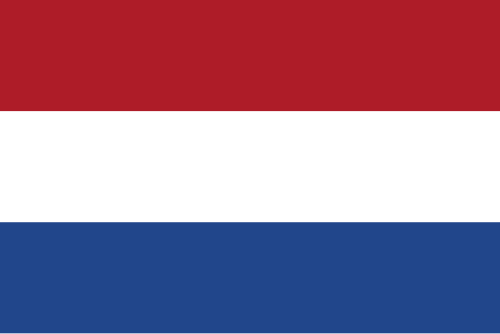
The national flag of the Netherlands is a horizontal tricolour of red, white, and blue. The current design originates as a variant of the late 16th century orange-white-blue Prinsenvlag, evolving in the early 17th century as the red-white-blue Statenvlag, the naval flag of the States-General of the Dutch Republic, making the Dutch flag the oldest tricolour flag in continuous use. As a flag that symbolises the transformation from monarchy to republic, it has inspired both the derivative Russian flag, and after the French Revolution in 1789, the vertically striped French tricolour; both flags in turn influenced many other tricolours. During the 1920s and the economic crisis of the 1930s, the old Prince's Flag with the colour orange gained some popularity among Protestants, Orangists, conservative liberals, fascists, and others. To end the confusion, the colours red, white and blue and its official status as the national flag of the Kingdom of the Netherlands were reaffirmed by royal decree on 19 February 1937.
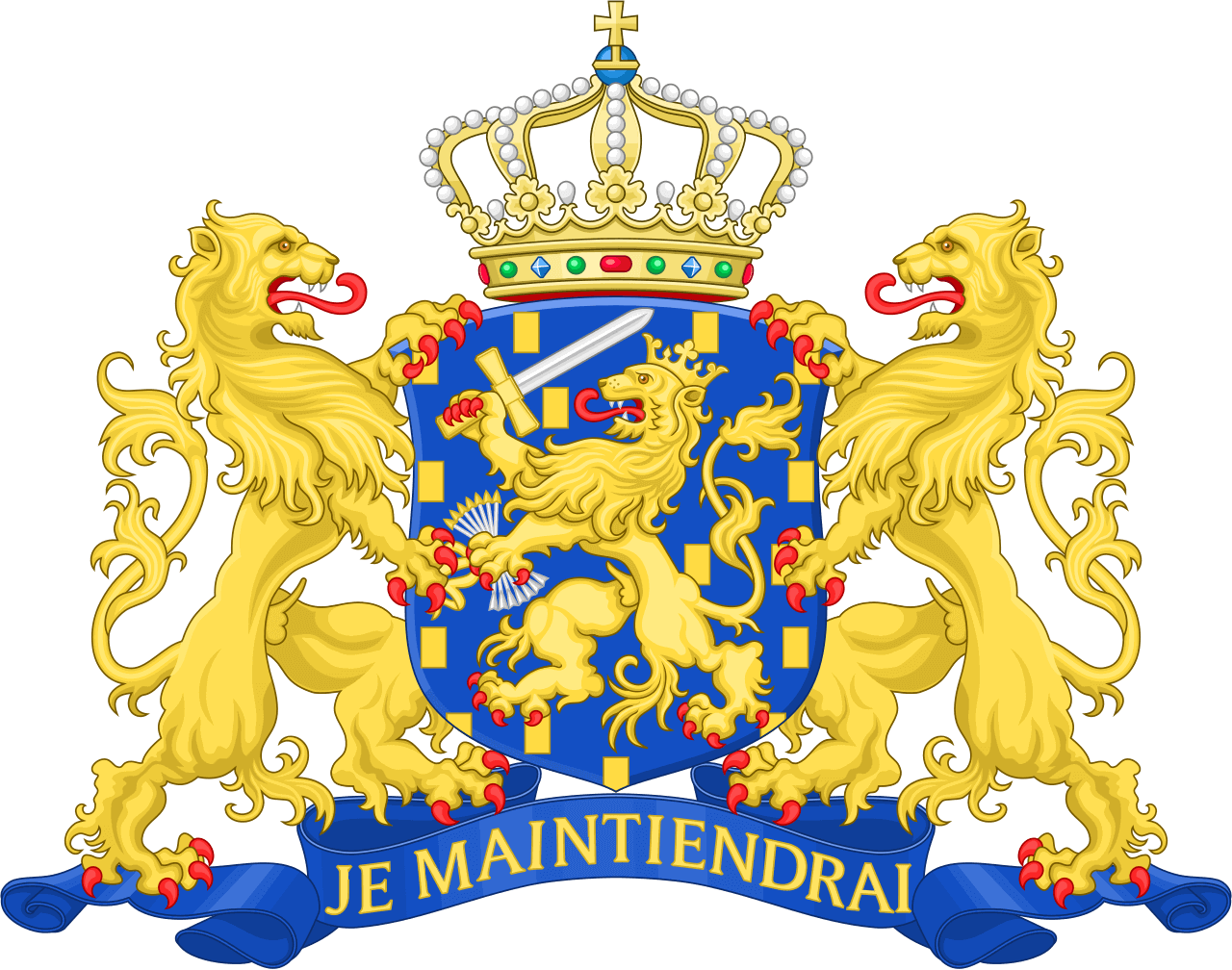
The coat of arms of the Kingdom of the Netherlands was originally adopted in 1815 and later modified in 1907. The arms are a composite of the arms of the former Dutch Republic and the arms of the House of Nassau, it features a shield, strewn with small rectangles and as its main element a lion grasping a sword in one hand and a bundle of arrows in the other and is the heraldic symbol of the monarch and the country. The monarch uses a version of the arms with a mantle while the government of the Netherlands uses a smaller version without the mantle (cloak) or the pavilion, sometimes only the shield and crown are used. The components of the coats of arms were regulated by Queen Wilhelmina in a royal decree of 10 July 1907, affirmed by Queen Juliana in a royal decree of 23 April 1980.
Beyond the national coat of arms, Netherlands is divided into regions and provinces, each carrying its own heraldic identity. Click on Netherlands on the interactive map to explore its administrative subdivisions and discover the coats of arms of each region, province, and territory.